Home
Class 11
PHYSICS
A uniform rod of length 60 cm and mass 6...

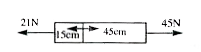
A uniform rod of length 60 cm and mass 6kg is acted upon by two forces as shown in the diagram. The force exerted by 45 cm part ofthe rod on 15 cm part of the rod is

A

9 N

B

18 N

C

27 N

D

30 N

Text Solution

Verified by Experts

The correct Answer is:

C
Promotional Banner

Similar Questions

Explore conceptually related problems

Figure shows a uniform rod of length 30 cm having a mass 3.0 kg. The rod is pulled by constant forces of 20N and 32N as shown. Find the force exerted by 20 cm part of the rod on the 10 cm part (all surfaces are smooth) is

One end of a uniform rod of length l and mass m is hinged at A. It is released from the rest from horizontal position AB as shown in figure. The force exerted by the rod on the hinge when it becomes verticle is

A uniform rod of the length of 1 m and mass of 2 kg is attached to side support at O as shown in the figure. The rod is at equilibrium due to upward force T acting at P . Assume the acceleration due to gravity as 10 ms ^(-2) The value of T is

A uniform cylindrical rod of length L and cross-sectional area by forces as shown in figure. The elongation produced in the rod is

A uniform cylindrical rod of length L, cross-section area A and Young's modulus Y is acted upon by the force as shown in Fig. 7(CF).3. The elongation of the rod is

A uniform rod of length l is applied upon by two forces at its either end as shown. Surface is smooth. Which of the following option is correct ?

A rod of length L and mass M is acted on by two unequal force F_(1) and F_(2) ( lt F_(1)) as shown in the following figure. The tension in the rod at a distance y from the end a is given by

A uniform rod of length L and mass M is pulled horizontally on a smooth surface with a force F . Determine the elongation of rod if Young's modulus of the material is Y .

A uniform rod of mass m and length is acted upon by the forces F_(1) and F_(2) Find that: a. linear-and angular acceleration of the rod. b. value of x for which the point P does not accelerate.

A metal rod of mass 10 gm and length 25 cm is suspended on two springs as shown in Fig. 1.131. The springs are extended by 4 cm. When a 20 A current passes through the rod, it rises by 1 cm. Determine the magnetic field assuming acceleration due to gravity to be 10 ms^-1.
