Home
Class 11
PHYSICS
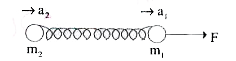
A spring connects two particles of masse...

A spring connects two particles of masses `m_1 and m_2` A horizontal force F acts on `m_1` Ignoring friction, when the elongation of the spring is x then:

A

`a_(2)=(kx)/m_2`

B

`a_(1)=(F-kx)/(m_1)`

C

`F=m_(1)a_(1)+m_(2)a_(2)`

D

`a_(1)=a_(2) =F/(m_(1)+m_(2)` at the time of maximum elongation of the spring .

Text Solution

Verified by Experts

The correct Answer is:

A, B, C, D
Promotional Banner

Similar Questions

Explore conceptually related problems

Two masses m_1 and m_2 are placed on a smooth horizontal surface and are connected by a string of negligible mass. A horizontal force F is applied on the mass m_2 as shown in the figure. The tension in the string is

Two particles of masses m_1 and m_2 are connected to a string and the system is rotated in a horizontal plane with 'P' as center. The ratio of tension in the two parts of string is

Two blocks of masses m and M connected by a light spring of stiffness k, are kept on a smooth horizontal surface as shown in figure. What should be the initial compression of the spring so that the system will be about to break off the surface, after releasing the block m_1 ?

An underformed spring of spring constant k is connected to a bead of mass m which can move along a frictionless rod as shown in the figure. If the particle strikes the bead at an angle of 45^(@) with the horizontal and sticks to it, then the maximum elongation of the spring after the collision is

Two blocks of masses m_(1) and m_(2) are connected by an ideal sprit, of force constant k . The blocks are placed on smooth horizontal surface. A horizontal force F acts on the block m_(1) . Initially spring is relaxed, both the blocks are at rest. Which of the following statement is not true tn the watt of above system.

Two identicle particles A and B, each of mass m, are interconnected by a spring of stiffness k. If particle B experiences a forec F and the elongation of the spring is x, the acceleration of particle B relative to particle A is equal to

Two blocks of masses m_(1) and m_(2) are connected by a spring of stiffness k. The coefficient of friction between the blocks and the surface is mu . Find the minimum constant force F to be applied to m_(1) in order to just slide the mass m_(2) .

Two blocks of masses m and M are connected by an inextensible light string . When a constant horizontal force acts on the block of mass M. The tension in the string is

When a force F acts on a particle of mass m, the acceleration of particle becomes a. now if two forces of magnitude 3F and 4F acts on the particle simultaneously as shown in figure, then the acceleration of the particle is

Two block of masses m_(1) and m_(2) connected by a light spring rest on a horizontal plane. The coefficient of friction between the block and the surface is equal to mu . What minimum constant force has to be applied in the horizontal direction to the block of mass m_(1) in order to shift the other block?
