Home
Class 11
PHYSICS
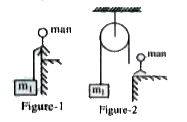
A block of mass 'm' is raised by a man o...

A block of mass 'm' is raised by a man of mass `m_2` in two different ways as shown (`m_1 = 25kg, m_2 = 50kg)`

A

The action of the man on the floor in first case is 750N

B

The action of the man on the floor in second case is 250N

C

The action of the man on the floor in first case is 250N

D

The action of the man on the floor in second case is 750

Text Solution

Verified by Experts

The correct Answer is:

A, B
Promotional Banner

Similar Questions

Explore conceptually related problems

A block of mass 25 kg is raised by a 50 kg man in two different ways as shown in figure. What is the action on the floor by the man in the two cases ? If the floor yields to a normal force of 700 N, which mode should the man adopt to lift the block without the floor yielding?

A block of mass 25 kg is raised by a 50kg man in two different ways as shown in fig. what is the action on the floor by the man in the two cases? If the floor yields to a normal force of 700N , which mode should the man adopt to lift the block without the floor yielding?

A block of mass m is placed on another block of mass M lying on a smooth horizontal surface as shown in the figure. The co-efficient of friction between the blocks is mu . Find the maximum horizontal force F (in Newton) that can be applied to the block M so that the blocks together with same acceleration? (M=3kg, m=2kg, mu=0.1, g=10m//s^(2))

A block of mass 1 kg is pushed towards another block of mass 2 kg from 6 m distance as shown in figure. Just after colision velocity of 2 kg block becomes 4 m//s .

Two blocks are placed at rest on a smooth fixed inclined place. A force F acts on block of mass m_1 and is parallel to the inclined plane as shown in figure. Both blocks move up the incline. Then (i) Draw free body diagram blocks of mass m_1 and blocks mass m_2 (ii) Find acceleration of blocks of mass m_1 and blocks mass m_2 (iii) Find normal reaction between the blocks of mass m_1 and m_2

A man of mass m=2kg is standing on a platform of mass M=5kg , then at any instant.

A block of mass 0.2 kg is attached to a mass less spring of force constant 80 N/m as shown in figure. Find the period of oscillation. Take g=10 m//s^(2) . Neglect friction

A body of mass 4 kg is attached to another body of mass 2 kg with a massless rod. If the 4 kg mass is at (2i + 5j)m and 2 kg mass is at (4i + 2j)m, the centre of mass of the system is at (in m)

A box of 50 kg is lifted by a man of mass 60 kg to a height of 50 m. Calculate the work done by the man.

A block of mass m=5kg is placed on the wedge of mass M=32kg as shown in the figure. Find the acceleration of wedge with respect to ground. (Neglect any type of friction. Spring and pulley are ideal)
