Home
Class 11
PHYSICS
The entires in column-II show soine arra...

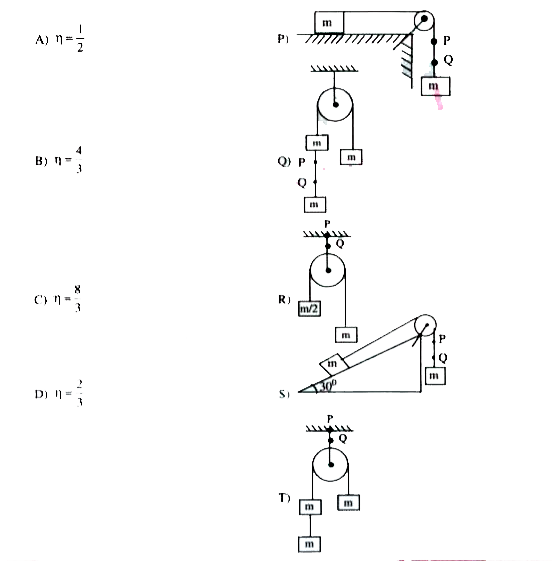
  The entires in column-II show soine arrangements of two or more blocks connected by ineans of light inextensible ropes and smooth pulleys. The tension in the string PQ is T = `eta mg` . Column-I lists, some value of `eta` Match appropriate options (neglect friction)

Text Solution

Verified by Experts

The correct Answer is:

A - P ; B - RS ; C - T ; D - Q
Promotional Banner

Similar Questions

Explore conceptually related problems

A block of mass M is placed on a rough horizontal surface. It is connected by means of a light inextensible string passing over a smooth pulley . The other end of string passing over a smooth pulley. The other end of string is connected to a block of mass m. There is no friction between vertical surface and block m If the coefficient of friction of friction mu is less than the above value, then downward acceleration of block m is

A block of mass M is placed on a rough horizontal surface. It is connected by means of a light inextensible string passing over a smooth pulley . The other end of string passing over a smooth pulley. The other end of string is connected to a block of mass m. There is no friction between vertical surface and block m If the whole system ( horizontal surface + blocks ) accelerates towards right the value of maximum on the horizontal surface is

A block of mass M is placed on a rough horizontal surface. It is connected by means of a light inextensible string passing over a smooth pulley . The other end of string is connected to a block of mass m. There is no friction between vertical surface and block m The minimum value of coefficient of friction mu such that system remains at rest , is

Consider the three cases given in figures shown. Assume the friction to be absent everywhere and the pulleys to be light, the string connecting the blocks to other block or fixed vertical wall to be light and inextensible. Let T_(A) , T_(B) and T_(C) be the tension in the strings in figure A , figure B and figure C respectively. Then pick the correct comparison between the given tension (for the instant shown) from options below.

In the arrangement shown, all string are light and inextensible, pulley is light and smooth. Given W_3 = 300 N . match the list in column-l to that in column-ll, when the system is in equilibrium

Consider the case of two bodies of masses m_(1) and m_(2) which are connected by light inextensible string passing over a light smooth pulley as shown in the figure. The expression for acceleration of the system and tension of the string are expressed below under different situations : ( i ) when m_(1) gt m_(2) . In this case a=((m_(1)-m_(2))/(m_(1)+m_(2)))g and T=((2m_(1)m_(2))/(m_(1)+m_(2)))g ( ii ) when m_(2) gt m_(1) . In this case a=((m_(2)-m_(1))/(m_(1)+m_(2)))g and T=((2m_(1)m_(2))/(m_(1)+m_(2)))g ( iii ) When m_(1)=m_(2)=m . In this case a=0 , T=mg If m_(1)=10kg , m_(2)=6kg and g=10m//s^(2) If the pulley is pulled upward with acceleration equal to the acceleration due to gravity, what will be the tension in the string

A conducting ring of mass m and radius r has a weightless conducting rod PQ of length 2r and resistance 2R attached to it along its diametre. It is pivoted at its centre C with its plane vertical, and two blocks of mass m and 2m are suspended by means of a light inextensible string passing over it as shown in Fig. The ring is free to rotate about C and the system is placed in magnetic field B (into the plane of the ring). A circuit is now complete by connecting the ring at A and C to a battery of emf V. It is found that for certain value of V , the system remains static. Net torque applied by the tension in strings can be related as

Consider the case of two bodies of masses m_(1) and m_(2) which are connected by light inextensible string passing over a light smooth pulley as shown in the figure. The expression for acceleration of the system and tension of the string are expressed below under different situations : ( i ) when m_(1) gt m_(2) . In this case a=((m_(1)-m_(2))/(m_(1)+m_(2)))g and T=((2m_(1)m_(2))/(m_(1)+m_(2)))g ( ii ) when m_(2) gt m_(1) . In this case a=((m_(2)-m_(1))/(m_(1)+m_(2)))g and T=((2m_(1)m_(2))/(m_(1)+m_(2)))g ( iii ) When m_(1)=m_(2)=m . In this case a=0 , T=mg If m_(1)=10kg , m_(2)=6kg and g=10m//s^(2) What is the tension in the string ?

Consider the case of two bodies of masses m_(1) and m_(2) which are connected by light inextensible string passing over a light smooth pulley as shown in the figure. The expression for acceleration of the system and tension of the string are expressed below under different situations : ( i ) when m_(1) gt m_(2) . In this case a=((m_(1)-m_(2))/(m_(1)+m_(2)))g and T=((2m_(1)m_(2))/(m_(1)+m_(2)))g ( ii ) when m_(2) gt m_(1) . In this case a=((m_(2)-m_(1))/(m_(1)+m_(2)))g and T=((2m_(1)m_(2))/(m_(1)+m_(2)))g ( iii ) When m_(1)=m_(2)=m . In this case a=0 , T=mg If m_(1)=10kg , m_(2)=6kg and g=10m//s^(2) then what is the acceleration of masses ?

List-I shows some arrangements in which motion of masses are described and list-II defines motion of centre of mass of the system (m + M). Match appropriate possible options in list-II
