Home
Class 11
PHYSICS
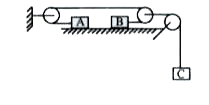
In the arrangement shown in figur m = mA...

In the arrangement shown in figur m `= m_A m_B = 2mB and m_c = M` . Assume all surfaes to be smooth and pulleys to be light, the acceleration of blcok C is

A

`(3Mg)/(3M+8m)`

B

`(Mg)/(3M+4m)`

C

`(2Mg)/(3M+4m)`

D

`(Mg)/(3m)`

Text Solution

Verified by Experts

The correct Answer is:

A
Promotional Banner

Similar Questions

Explore conceptually related problems

If the string & all the pulleys are ideal, acceleration of mass m is :-

In the arrangement shown in Figure, m_A=2kg and m_B=1kg . String is light and inextensible. Find the acceleration of centre of mass of both the blocks. Neglect friction everywhere.

In the arrangement shown in Figure, m_A=2kg and m_B=1kg . String is light and inextensible. Find the acceleration of centre of mass of both the blocks. Neglect friction everywhere.

All the surfaces are smooth as shown in figure. The acceleration of mass m relative to wedge is :

Consider the situation shown in figure .Both the pulleys and the string and light and all the surfaces are smooth. (a) Find the acceleration of 1kg block. (b) Find the tension in the string. (g = 10 m//s^(2)) .

Three blocks of masses m_1, m_2 and m_3 are connected as shown in the figure. All the surfaces are frictionless and the string and the pulleys are light. Find the acceleration of m_1

Find the acceleration of the body of mass m_(2) in the arrangement shown in figure. If the mass m_(2) is eta time the mass m_(1) and the angle that the inclined plane forms with the horizontal is equal to theta . The masses of the pulley and threads, as well as the friction, are assumed to be negligible.

In the arrangement shown in the figure , the rod of mass m held by two smooth walls , remain always perpendicular to the surface of the wedge of mass M . Assuming all the surface are frictionless, find the acceleration of the rod wedge.

In the arrangement shown in figure, the rod of mass m held by two smooth walls, remains always perpendicular to the surface of the wedge of mass M . Assumming all the surface to be frictionless, find the acceleration of the rod and that of the wedge.

In the arrangement shown in fig. pulleys are smooth and massless. Threads are massless and inextensible. Find acceleration of mass m_(1) .
