Home
Class 11
PHYSICS
what is the relation between speeds of p...

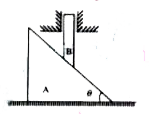
what is the relation between speeds of points A and B in the given figure. Slender rod is constrained to move vertically down and wedge is constrained to move along horizontal

A

`a_B=a_A Cot theta`

B

`a_B=a_A Tan theta`

C

`a_A = a_B Cos theta`

D

`a_B = a_A sec theta`

Text Solution

Verified by Experts

The correct Answer is:

B
Promotional Banner

Similar Questions

Explore conceptually related problems

What is the relation between wavelength and momentum of moving particles ?

A vertical rod of mass m is kept on a wedge of mass M. If a horizontal force F acts on the wedge and the rod is constrained to move vertically, after releasing the rod-wedge system, (a) find their speeds when the wedge moves through a distance x. (b) What is the power delivered by the rod on the wedge aftre a time t measured from the instant of release?

In the figure if block A and wedge b will move with same acceleration, then the magnitude of normal reaction between the block and the wedge will be (There is no friction between block and the wedge and the wedge moves on horizontal surface as shown.)

In fig, no relative motion takes place between the wedge and the block placed on it. The rod slides down wards over the wedge and pushes the wedge to move in horizontal direction, The mass of wedge is same as that of the block and is equal to M. If tan theta=(1//sqrt(3)) , find the mass of rod. (Neglect rotation of the rod).

A ball with mass m is attached to the end of a rod of mass M and length l . The other end of the rod is pivoted so that the ball can move in a vartical circle. The rod is held in the horizontal position as shown in figure and then given just enough a downward push so that the ball swings down and just reaches the vertical upward position having zero speed there. Now answer the following questions. The initial speed given to the ball is

A ball with mass m is attached to the end of a rod of mass M and length l . The other end of the rod is pivoted so that the ball can move in a vartical circle. The rod is held in the horizontal position as shown in figure and then given just enough a downward push so that the ball swings down and just reaches the vertical upward position having zero speed there. Now answer the following questions. The change in potential energy of the system (ball+rod) is

A ball of mass m moving horizotally which velocity u hits a wedge of mass M . The wedge is situated on a smooth horizontal source. If after striking with wedge the ball starts moving in vertical direction and the wedge starts moving in horizotal plane. calculate a. the velocity of wedge V . b. the velocity (v) at which the ball moves in vertical direction. c. the impulse imparted by the ball on the wedge. d. the coefficient of restitution e=?

A shell of mass m is moving horizontally with velocity v_(0) and collides with the wedge of mass M just above points A, as shown in the figure. As a consequences, wedge starts to move towards left and the shell returns with a velocity in xy-plance. The principle of conservation of momentum can be applied for

A light beam travelling in the x-direction is described by the electric field : E_(y) = 270 "sin" omega(t-(x)/(c)). An electron is constrained to move along the y-direction with a speed of 2.0xx10^(7) "ms"^(-1). find the maximum electric force and maximum magnetic force on the electron.

Find the period of oscillation of a pendulum of length l if its point of suspension is (a) moving vertically up with acceleration a (b) moving vertically down with acceleration a(lt g) (c) failing freely under gravity moving horizontal with acceleration a .
