Home
Class 11
PHYSICS
Same spring is attached with 2kg, 3kg an...

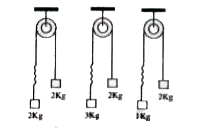
Same spring is attached with 2kg, 3kg and lkg blocks in three different cases as shown in figure. Let x be the extension produced in a spring. Then,

A

`x_1 = 0, x_3 gtx_2`

B

`x_2 gt x_1 gt x_3`

C

`x_3gt x_1 gt x_2`

D

`x_1 gt x_2 gt x`

Text Solution

Verified by Experts

The correct Answer is:

B
Promotional Banner

Similar Questions

Explore conceptually related problems

Same spring is attached with 2kg , 3kg and 1kg blocks in three different cases as shown in figure. If x_(1) , x_(2) and x_(3) be the extensions in the spring in these cases then (Assume all the block s to move with uniform acceleration).

A block of mass 1kg is placed on a rough horizontal surface. A spring is attached to the block whose other end is joined to a rigid wall, as shown in the figure. A horizontal force is applied on the block so that it remains at rest while the spring is elongated by x(xge(mumg)/(k)) . Let F_(max) and F_(mi n) be the maximum and minimum values of force F for which the block remains in equilibrium. For a particular x, F_(max)-F_(mi n)=2N . Also shown is the variation of F_(max)+F_(mi n) versus x , the elongation of the spring. The spring constant of the spring is :

Two springs are in a series combination and are attached to a block of mass 'm' which is in equilibrium. The spring constants and extension in the springs are as shown in the figure. Then the force exerted by the spring on the block is :

From the fixed pulley, masses 2 kg, 1 kg and 3 kg are suspended as shown is figure. Find the extension in the spring when acceleration of 3 kg and 1 kg is same if spring constant of the spring k = 100 N/m. (Take g = 10 ms^(-2) )

Natural length of a spring is 60 cm and its spring constant is 4000 N/m. A mass of 20 kg is hung from it. The extension produced in the spring is (Take, g = 9.8 m//s^(2) )

Two identical springs of spring constant k are attached to a block of mass m and to fixed supports as shown in the figure. The time period of oscillation is

A dynamometer D is attached to two blocks of masses 6 kg and 4 kg as shown in the figure. The reading of the dynamometer is

From the fixed pulley, masses 2kg, 1kg and 3kg are suspended as shown in the figure. Find the extension in the spring if k=100 N//m . (Neglect oscillations due to spring)

Two masses of 1 kg and 5 kg are attached to the ends of a massless string passing over a pulley of negligible weight. The pulley itselt is attached to a light spring balance as shown in figure. The masses start moving during this interval, the readcing of spring balance will be-

Two masses of 1 kg and 5 kg are attached to the ends of a massless string passing over a pulley of negligible weight. The pulley itselt is attached to a light spring balance as shown in figure. The masses start moving during this interval, the readcing of spring balance will be-
