Home
Class 11
PHYSICS
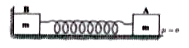
The block A is pushed towards the wall b...

The block A is pushed towards the wall by a distance and released. The normal reaction by vertical wall on the block B v/s compression in spring is given by :

A

B

C

D

Text Solution

Verified by Experts

The correct Answer is:

A
Promotional Banner

Similar Questions

Explore conceptually related problems

Two blocks A and B of mass m and 2m are connected together by a light spring of stiffness k . The system is lying on a smooth horizontal surface with block A in contact with a fixed vertical wall as shown in the figure. The block B is pressed towards the wall by a distance x_0 and then released. There is not friction anywhere. If spring takes time Deltat to aquire its natural length then average force on the block A by the wall is

Figure shown a block P of mass m resting on a smooth floor at a distance l from a regid wall. Block is pushed towards right by a distance 3//2 and released. When block passes from its mean position another block of mass m_(1) so that the combined block just collides with the left wall.

Figure shows a block P of mass m resting on a smooth floor at a distance l from a rigid wall. Block is pushed towards right by a distance 3l/2 and released. When block passes from its mean position another block of mass m_(1) is dropped over it, find the minimum value of m_(1) so that the combined block just collides with the left wall.

In the figure, the block of mass m, attached to the spring of stiffness k is in correct with the completely elastic wall, and the compression in the spring is e. The spring is compressed further by e by displacing the block towards left and is then released. If the collision between the block and the wall is completely eleastic then the time period of oscillation of the block will be

Block A is moving away from the wall at a speed v and acceleration a.

A block (B) is attached to two unstriched sprig S_(1) and S_(2) with spring constant K and 4K , respectively (see fig 1) The other ends are atteched in identical support M_(1) and M_(2) not attached in the walls . The springs and supports have negligible mass . There is no friction anywhere . The block B is displaced toword wall 1 by a small distance x (figure (ii)) and released . The block return and moves a maximum distance y towards wall 2.Displacements x and y are measured w.r.to the equalibrum of the block B and the ratio y//x is

A block of mass m is attached to two unstretched springs of spring constant k , each as shown. The block is displaced towards right through a distance x and is released The speed of the block as it passes through the mean position will be

A block of 50 N is pressed normally against a wall as shown. The frictional force acting on the block is : ]

The spring is compressed by a distance a and released. The block again comes to rest when the spring is elongated by a distance b . During this

A block is mass m moves on as horizontal circle against the wall of a cylindrical room of radius R. The floor of the room on which the block moves is smooth but the friction coefficient between the wall and the block is mu . The block is given an initial speed v_0 . As a function of the speed v write a. the normal force by the wall on the block. b. the frictional force by the wall and c. the tangential acceleration of the block. d. Integrate the tangential acceleration ((dv)/(dt)=v(dv)/(ds)) to obtain the speed of the block after one revoluton.
