Home
Class 11
PHYSICS
A dynamometer D is attached to weights o...

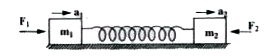
A dynamometer D is attached to weights of masses `m_1 and m_2` Two forces `F_1 and F_2` are applied to the masses `F_1 and F_2` as shown. The entire arrangement is there on a smooth horizontal surface.

The net acceleration of the system is

A

`(barF_1+barF_2)/(m_1+m_2)`

B

`(F_1-F_2)/(m_1+m_2)`

C

`(F_2-F_1)/(m_1+m_2)`

D

`(F_2+F_1)/(m_1+m_2)`

Text Solution

Verified by Experts

The correct Answer is:

A, B, C
Promotional Banner

Similar Questions

Explore conceptually related problems

A dynamometer D is attached to two bodies of masses M=6 kg and m=4 kg. Force F=20 N and f=10N are applied to the masses as shown. The dynometer reads

A constant force F = m_(2)g//2 is applied on the block of mass m_(1) as shown in fig. The string and the pulley are light and the surface of the table is smooth. The acceleration of m_(1) is :

At t=0 , a force F=at^(2) is applied to a small body of mass m at an angle alpha resting on a smooth horizontal plane

A horizontal force F pushes wedge of mass M on a smooth horizontal surface. A block of mass m is stationary to the wedge, then:

A block of mass m = 10 kg is pulled by a force F = 100 N at an angle theta=30^(@) with the horizontal along a smooth horizontal surface. What is the acceleration of the block? (g = 10m//s^(2))

A uniform rod of mass M and length L lies flat on a frictionless horizantal surface. Two forces F and 2F are applied along the length of the rod as shown. The tension in the rod at point P is

A horizontal force F acts on a wedge of mass m_1 as shown. A block of mass is placed on the front wall of my. Assuming all contact surfaces to be smooth and m_2 moves on a smooth horizontal surface.

A force F=75 N is applied on a block of mass 5 kg along the fixed smooth incline as as shown in the figure. Here gravitational acceleration g = 10 m s^(-2) . The acceleration of the block is

Two blocks A and B of masses m and M are attached with ideal string and pulley, and placed on smooth horizontal surface. Force F is applied horizontally as shown in figure. Find the ratio of the acceleration of A to that of B.

When forces F_1 , F_2 , F_3 , are acting on a particle of mass m such that F_2 and F_3 are mutually perpendicular, then the particle remains stationary. If the force F_1 is now removed then the acceleration of the particle is
