Home
Class 11
PHYSICS
A dynamometer D is attached to weights o...

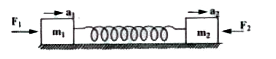
A dynamometer D is attached to weights of masses `m_1 and m_2` Two forces `F_1 and F_2` are applied to the masses `m_1 and m_2` as shown. The entire arrangement is there on a smooth horizontal surface.

The reading of the dynamometer in the above arrangement is

A

`(F_1-F_2)/(2)`

B

`(F_1+F_2)/(2)`

C

`(F_2-F_1)/(2)`

D

`F_2-F_1`

Text Solution

Verified by Experts

The correct Answer is:

B
Promotional Banner

Similar Questions

Explore conceptually related problems

A dynamometer D is attached to two bodies of masses M=6 kg and m=4 kg. Force F=20 N and f=10N are applied to the masses as shown. The dynometer reads

Two bodies of masses m_1 and m_2(

A dynamometer D is attached to two blocks of masses 6 kg and 4 kg as shown in the figure. The reading of the dynamometer is

At t=0 , a force F=at^(2) is applied to a small body of mass m at an angle alpha resting on a smooth horizontal plane

A horizontal force F pushes wedge of mass M on a smooth horizontal surface. A block of mass m is stationary to the wedge, then:

A dynamometer D, which is a device used to measure force, is attached to two blocks of masses 6 kg and 4 kg. Forces of 20 N and 10 N are applied on the blocks as shown in the figure. The reading of the dynamometer is

In the arrangement shown, the pulleys, string and the spring balance, all the ideal. If m_(1) gt m_(2) , then the reading of the spring balance is

A horizontal force F acts on a wedge of mass m_1 as shown. A block of mass is placed on the front wall of my. Assuming all contact surfaces to be smooth and m_2 moves on a smooth horizontal surface.

A constant force F = m_(2)g//2 is applied on the block of mass m_(1) as shown in fig. The string and the pulley are light and the surface of the table is smooth. The acceleration of m_(1) is :

A disc of mass M = 4 kg, radius R = 1 m is attached with two blocks A and B of masses 1 kg and 2 kg respectively on rim and is resting on a horizontal surface as shown in the figure. Find angular frequency of small oscillation of arrangement:
