Home
Class 11
PHYSICS
A ball is held at rest at position A by ...

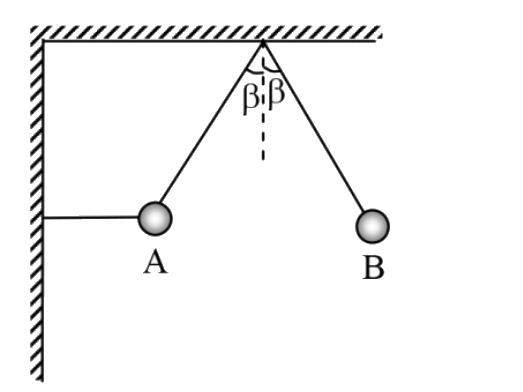
A ball is held at rest at position A by two light strings. The horizontal string is cut and the ball starts swinging like a pendulum. Point B is the farthest to the right the ball goes as it swings back and forth. What is the ratio of the tension in the supporting string in position B to its value at A before the horizontal string was cut?

Text Solution

Verified by Experts

The correct Answer is:

5
Promotional Banner

Similar Questions

Explore conceptually related problems

A ball is held at rest in position A by two light cords. The horizontal cord is now cut and the ball swings to the position B. What is the ratio of the tension in the cord in position B to that in position A?

Using two light cords a bob is held in equilibrium at A. The horizontal cord is cut and the bob is allowed to swing as a pendulum. Calculate the ratio of the tension in the supporting cord in position B to that in position A.

Two balls of masses m_(1)=5kg, m_(2)=10kg are connected by a light inextensible string. A horizontal force F = 15 N is acting on the ball m_(2) along the line joining two balls as shown. What is the (a) acceleration of the balls (b) tension in the string?

A ball of mass 1kg is at rest in position P by means two light strings OP and RP . The string RP is now cut and the ball swings to position Q . If theta =45^(@) . Find the tensions in the strings in position OP (when RP was not cut ) and OQ (when RP was cut ). (take g =10m//s^(2) ).

A simple pendulum swings with angular amplitude theta . The tension in the string when it is vertical is twice the tension in its extreme position. Then, cos theta is equal to

Figure shows a small ball of mass m held at rest by means of two light and inextensible strings. The tensions in the inclined string at the instant shown and just after cutting the horizontal atring are respectively

A particle is suspended by a light vertical inelastic string of length 1 from a fixed support. At its equilbrium position it is projected horizontally with a speed sqrt(6 g l) . Find the ratio of the tension in the string in its horizontal position to that in the string when the particle is vertically above the point of support.

A thin uniform bar of mass m and length 2L is held at an angle 30^@ with the horizontal by means of two vertical inextensible strings, at each end as shown in figure. If the string at the right end breaks, leaving the bar to swing, determine the tension in the string at the left end and the angular acceleration of the bar immediately after string breaks.

If the string of an oscillating simple pendulum is cut, when the bob is at the mean position, the bob falls along a parabolic path. The bob possesses horizontal velocity at the mean position.

A uniform rod of mass m and length L is suspended with two massless strings as shown in the figure. If the rod is at rest in a horizontal position the ratio of tension in the two strings T_1/T_2 is:
