Home
Class 11
PHYSICS
In the adjoining figure all surfaces are...

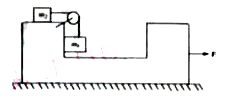
In the adjoining figure all surfaces are frictionless, strings are light and inextensible. Consider a force F to be applied. So that block m, neither raises nor falls.

A

Value of F is `(m_3(m_1 + m_2 + m_3)g)/(m_2)`

B

The acceleration of the system is `(m_3g)/m_2`

C

Tension in the string connecting `m_1 and m_2` is

D

The force exerted by pulley on wedge `m_3` is ` sqrt2(m_3g)`

Text Solution

Verified by Experts

The correct Answer is:

A, B, C, D
Promotional Banner

Similar Questions

Explore conceptually related problems

There blocks a,b and c of massses 10 kg ,10 kg and 20 kg respectivaly are arrenged as shown in figure all the surface are frictionless and string is inextensible A constant force F= 20N is applied on block a as shown . pulley and string are light . part of the string connecting both pulleys is vertical and part of the string connecting pulleys with masses a and b are horizontal .

Three blocks of masses m_(1), m_(2) and M are arranged as shown in figure. All the surfaces are fricationless and string is inextensible. Pulleys are light. A constant force F is applied on block of mass m_(1) . Pulleys and string are light. Part of the string connecting both pulleys is vertical and part of the strings connecting pulleys with masses m_(1) and m_(2) are horizontal. {:((P),"Accleration of mass " m_(1),(1) F/(m_(1))),((Q),"Acceleration of mass" m_(2),(2) F/(m_(1)+m_(2))),((R),"Acceleration of mass M",(3) "zero"),((S), "Tension in the string",(4) (m_(2)F)/(m_(1)+m_(2))):}

In the adjoining figure all surface are frictionless . What force F must by applied to M_(1) to keep M_(3) free from rising or falling?

In the system shown in figure all surfaces are smooth. Strings is massless and inextensible.Find acceleration of the system and tension T in the string (g=10m//s^(2))

In the given arrangement shown in figure, surface is frictionless, string is inextensible and massless, pulley B is frictionless. Length of the string is l . At t=0 , AB=l . Find out the velocity of block C , when distance between blocks is minimum, it is was released from rest at t=0 .

Consider the situation shown in figure. All the surfaces are frictions and the string and the pulley are light. Find the magnitude of the acceleration of the two blocks.

In the system shown all the surfaces are frictionless while pulley and string are massless. The mass of block A is 2m and that of block B is m. The acceleration of block B immediately after system is released from rest is

In the arrangement shown in figure. The strings are light and inextensible. The surface over which block are placed is smooth.Find (a) the acceleration of each block, (b) the tension in each string.

In the situation shown in fig., all the strings are light and inextensible and pullies are light. There is no friction at any surface and all blocks are of cuboidal shape. A horizontal force of magnitude F si applied to right most free end of string in both cases shown in the figure. At the instant shown, the tension in all strings are non-zero. Let the magnitudes of acceleration of large blocks (of mass M) in fig. be a_(1) and a_(2) respectively. Then,

In the arrangement shown in fig. The strings are light and inextensible. The surface over which blocks are placed is smooth. Find: (a) the acceleration of each block. (b) the tension in each string.
