Home
Class 11
PHYSICS
Three identical cylinders, each of weigh...

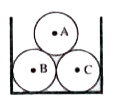
Three identical cylinders, each of weight 100 N are placed in an arrangement of width 20 cm as shown. Match the list in column-I with forces mentioned against values mentioned in column-II `N_1` : reaction force between floor and cylinder B `" "N_2` : reaction force between wall and cylinder B
`N_3` reaction force between cylinder A and cylinder B
`N_4` : resultant vertical force on A
`{:("Column - I ","Column - II"),("A)" N_1 ,"P)" 100N),("B)" N_2,"Q)" 100/sqrt3N),("C)" N_3,"R)" 50/sqrt3N),("D)" N_4,"S)" 150 N):}`

Text Solution

Verified by Experts

The correct Answer is:

`A - S; B - R ; C-Q ; D-P`
Promotional Banner

Similar Questions

Explore conceptually related problems

Three identical each of weight 100 N and diameter 10 cm are placed in channel of 20 cm width as shown in figure. The magnitude of normal force on B from

Match the list in Column-I with the list in Column-II Column-I list shows a list of fundamental interactive forces, Column-II is list of operational area of these forces

Five equal forces each of 20N are acting at a point in the same plane. If the angles between them are same, the resultant of these forces is

A body of weight 50 N placed on a horizontal surface is just moved by a force of 28.2 N. the frictional force and the narmal reaction are

Three identical rigid circular cylinder A B and C are arrenged on smooth inclined surfaces as shown in figure. The laest value of theta that prevent the arrangement from collapes is.

The diagram shows a rough plank resting on a cylinder with one and of the plank on rough ground. Negtect friction between plank and cylinder. Draw digrams to show (a) the force acting on the plank, (b)the force acting on the cylinder.

A clockwise torque of 6N-m is applied to the circular cylinder as shown in the figure. There is no friction between the cylinder and the block.

Two identical spheres of radii 10 cm each are placed in between two rigid walls (vertical) as shown. The spacing between the walls is 36 cm. Then find the force of contact between the spheres, if the weight of each sphere is 'W'.

Given in figure are two blocks A and B of weight 20N and 100N, respectively. These are being pressed against a wall by a force F as shown. If the coefficient of friction between the blocks is 0.1 and between block B and the wall is 0.15, the frictional force applied by the wall on block B is:
