Home
Class 11
PHYSICS
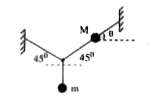
Two masses m and M are attched with stri...

Two masses m and M are attched with strings as shwon . If the system is in equilibrium then , `tan theta `

A

`M/m`

B

`(2M)/m`

C

`1+M/m`

D

`1+((2M)/m)`

Text Solution

Verified by Experts

The correct Answer is:

D
Promotional Banner

Similar Questions

Explore conceptually related problems

Two masses m and M are attached with strings as shown. For the system to be in equilibrium we have.

Two masses m and M are attached to the strings as shown in the figure. If the system is in equilibrium, then

Two bodies of masses m and 4 m are attached with string as shown in the figure. The body of mass m hanging from a string of length l is executing oscillations of angular amplitude theta_(0) while the other body is at rest. The minimum coefficient of friction between the mass 4m and the horizontal surface should be

Figure, represents a light inextensible string ABCDE in which AB=BC=CD=DE and to which are attached masses M,m, and M at the point B,C and D, respectively. The system hangs freely in equilibrium with ends A and E of the string fixed in the same horizontal line. it is given that tan alpha=3//4 and tan beta=12//5 . Then the tension in the string BC is

If system is in equilibrium then find relation between m_(1) and m_(2)

Two particles of masses m_1 and m_2 are connected to a string and the system is rotated in a horizontal plane with 'P' as center. The ratio of tension in the two parts of string is

The pulleys and strings shown in fig are smooth and of negligible mass. For the system to remain in equilibrium the angle theta should be:

Three blocks A,B and C are suspended as shown in the figure. Mass of each block A and C is m. if the system is in equilibrium and mass of B is M, then

Three blocks A,B, and C are suspended as shown in fig. Mass of each of blocks A and B is m. If the system is in equilibrium, and mass of C is M then

Two identical ladders, each of mass M and length L are resting on the rough horizontal surface as shown in the figure. A block of mass m hangs from P. if the system is in equilibrium, find the magnitude and the direction of frictional force at A and B.
