Home
Class 11
PHYSICS
A light smooth inextensible string conne...

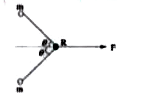
A light smooth inextensible string connected with two identical particles each of mass m, passes through a light ring R. If a force F pulls ring, the relative acceleration between the particles has magnitude :

A

`(2F)/m tan theta`

B

`(Fsec theta)/(m)`

C

`F/m tan theta`

D

zero

Text Solution

Verified by Experts

The correct Answer is:

C
Promotional Banner

Similar Questions

Explore conceptually related problems

Consider a system of two identical particles. One of the particles is at rest and the other has an acceleration. The centre of mass has an acceleration.

A ring of mass m = 0.3kg can slide freely on smooth vertical rod. A light and inextensible string is connected to the ring and passes over a smooth and fixed pulley as shown in the figure. The distance of the pulley from the rod is 0.8m and the other end of the string is connected to a block of mass M = 0.5kg. The ring is held in level with pulley and then released from rest. The distance by which the ring moves down before coming to rest for the first time is 0.75K. Find K.

A monkey pulls the midpoint of a 10 cm long light inextensible string connecting two identical objects A and B lying on smooth table of masses 0.3 kg continuously along the perpendicular objects of line joining the masses .The masses are found to apporoach each other at a relative acceleration of 5 m s^(-2) when they are 6 cm apart .The constant force applied by monkey is

A block of mass M is connected with a particle of mass m by a light inextensible string as shown in fig. Assuming all contaction surfaces as smooth, find the acceleration of the wedge after releasing the system.

Two particles A and B having equal mass are interconnected by a light inextensible string that passes over a smooth pulley. One of the amsses is pulled downward by a constant force 'F' as shown in diagram, then find the acceleration of the centre of mass of the system (A+B) .

Two particles each of mass m are connected by a light inextensible string and a particle of mass M is attached to the midpoint of the string. The system is at rest on a smooth horizontal table with string just taut and in a straight line. The particle M is given a velocity v along the table perpendicular to the string. Prove that when the two particles are about to collide : (i) The velocity of M is (Mv)/((M + 2m)) (ii) The speed of each of the other particles is ((sqrt2M (M + m))/((M + 2m)))v .

Two particles of masses m and M(Mgtm) are connected by a cord that passes over a massless, frictionless pulley. The tension T in the string and the acceleration a of the particles is

A small ring of mass m is constrained to slide along a horizontal wire fixed between two rigid supports. The ring is connected to a particle of same mass by an ideal string & the whole system is released from rest as shown in the figure. If the coefficient of friction between ring A and wire is (3)/(5) , the ring will start sliding when the connecting string will make an angle theta with the vertical, then theta will be (particle is free to move and ring can slide only)

A particle of mass m is tied to light string and rotated with a speed v along a circular path of radius r. If T=tension in the string and mg= gravitational force on the particle then actual forces acting on the particle are

In figure two identical particals each of mass m are tied together with an inextensible string. This is pulled at its centre wwith a constant force F . If the whole system lines on a smooth horizontal plane, then the aceleration of each partical towards each other is
