Home
Class 11
PHYSICS
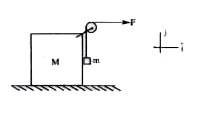
In the arrangement shown surfaces are sm...

In the arrangement shown surfaces are smooth, pulley is ideal and string is light. If `F=(Mg)/2` , then

A

acceleration of the larger block is `g/2 hati`

B

acceleration of the larger block is `g/4 hati`

C

acceleration of the smaller block is `g/4 hati +g/2(-hatj)`

D

acceleration of the smaller block is `g/4 hati `

Text Solution

Verified by Experts

The correct Answer is:

B, C
Promotional Banner

Similar Questions

Explore conceptually related problems

In the arrangement shown, all the surface are smooth, strings and pulleys are light. Find the tension in the string.

In the arrangement shown in figure, pulley is smooth and massless and all the strings are light. Let F_(1) be the force exerted on the pulley in case (i) and F_(2) the force in case (ii). Then :

In the arrangement shown, the pulleys, string and the spring balance, all the ideal. If m_(1) gt m_(2) , then the reading of the spring balance is

In the arrangement shown, inclined plane is smooth, strings and pulleys are massless. Find T_(1)/T_(2)

In the figure shown, all surfaces are smooth and the pulley is massless. A constant force of magnitude F = (mg)/(2) is acting on the block of mass M. The acceleration of the block M is :

In the arrangement shown in fig. m_(1)=1kg, m_(2)=2 kg . Pulleys are massless and strings are light. For what value of M, the mass m_(1) moves with constant velocity.

In the arrangement shown in the figure the elevator is going up with an acceleration of g/10. If the pulley and the string are light and the pulley is smooth, the tension in the string AB is

In the arrangement shown, all string are light and inextensible, pulley is light and smooth. Given W_3 = 300 N . match the list in column-l to that in column-ll, when the system is in equilibrium

In the arrangement shown, the pulleys and strings are massless. The acceleration of block B is :

In the arrangement shown in fig. pulleys are smooth and massless. Threads are massless and inextensible. Find acceleration of mass m_(1) .
