Home
Class 11
PHYSICS
In the spring block (mass) & wedge syste...

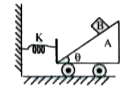
In the spring block (mass) & wedge system shown in the arrangement, the systems are in equilibrium as shown in the arrangement, the systems are in equilibrium. The force constant of spring is K. All contact surfaces are smooth
Block B has a mass m and is released from the extension top of the wedge A (of mass 3m). The equilibrium extension of the spring can be

A

`(2mgcos theta)/(K)`

B

`(mg cos theta)/K`

C

`(mg sin 2 theta)/(2K)`

D

`(mg sin 2 theta)/K`

Text Solution

Verified by Experts

The correct Answer is:

C
Promotional Banner

Similar Questions

Explore conceptually related problems

For the system shown in figure , to be in equilibrium , determine mass m .

In the adjoining figure, block A is of mass (m) and block B is of mass2 m. The spring has force constant k. All the surfaces are smooth and the system is released form rest with spring unstretched. .

All surfaces shown in figure are smooth system is released with the spring unstretched In equilibrium, compression in the spring will be

All surfaces shown in figure are smooth system is released with the spring unstretched In equilibrium, compression in the spring will be

There are two identical spring each of spring constant k. here springs, pulley and rods are massless and the block has mass m . What is the extension of each spring at equilibrium?

A mass M is suspended as shown in fig. The system is in equilibrium. Assume pulleys to be massless. K is the force constant of the spring. The extension produced in the spring is given by

An ideal spring with spring constant k is hung from the ceiling and a block of mass M is attached to its lower end. The mass is released with the spring initially unstretched. Then the maximum extension in the spring is

An ideal spring with spring constant k is hung from the ceiling and a block of mass M is attached to its lower end. The mass is released with the spring initially unstretched. Then the maximum extension in the spring is

Find the reading of spring balance as shown in fig. Assume that mass M in equilibrium. (All surfaces are smooth).

For the equilibrium of the system shown, the value of mass m should be
