Home
Class 11
PHYSICS
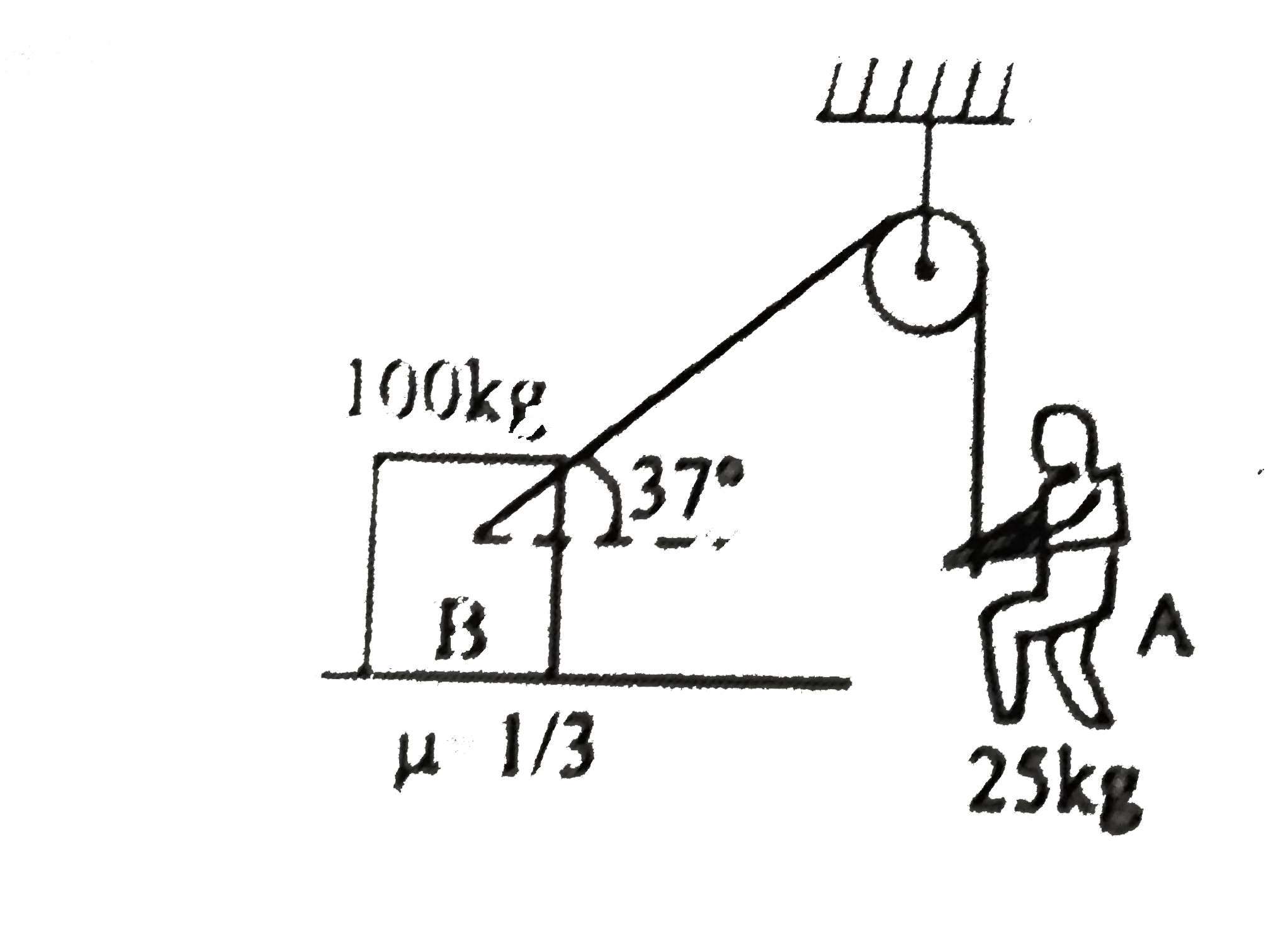
Block B of mass 100 kg rests on a rough ...

Block B of mass 100 kg rests on a rough surface of friction coeffcient `mu= 1//3.` A rope is tied to block B as shown in figure. The maximum acceleration with which boy A of 24 kg can climbs on rope without making block move is :

A

`(4g)/(3)`

B

`(g)/(3)`

C

`(g)/(2)`

D

`(3g)/(4)`

Text Solution

Verified by Experts

The correct Answer is:

B
Promotional Banner

Similar Questions

Explore conceptually related problems

A block of mass 10 kg is moving on a rough surface as shown in figure. The frictional force acting on block is :-

A body of mass 60 kg is holding a vertical rope . The rope can break when a mass of 75 kg is suspended from it. The maximum acceleration with which the boy can climb the rope without breaking it is : ( g = 10 m//s^(2))

The maximum tension a rope can withstand is 60 kg.wt. The ratio of maximum acceleration with which two boys of masses 20 kg and 30 kg can climb up the rope at the same time is

A block of 10 kg mass is placed on a rough inclined surface as shown in figure. The acceleration of the block will be

A block of mass 10kg is placed on a rough horizontal surface having coefficient of friction mu=0.5 . If a horizontal force of 100N is acting on it, then acceleration of the will be.

A block of mass 10kg is placed on a rough horizontal surface having coefficient of friction mu=0.5 . If a horizontal force of 100N is acting on it, then acceleration of the will be.

A block of mass 10kg is placed on a rough horizontal surface having coefficient of friction mu=0.5 . If a horizontal force of 100N is acting on it, then acceleration of the block will be.

A block of mass 10kg is placed on a rough horizontal surface having coefficient of friction mu=0.5 . If a horizontal force of 100N is acting on it, then acceleration of the block will be.

A block of mass m is pulled by a constant powert P placed on a rough horizontal plane. The friction coefficient the block and surface is mu . The maximum velocity of the block is.

Block B of mass 2 kg rests on block A of mass 10 kg. All surfaces are rough with the value of coefficient of friction as shown in the figure. Find the minimum force F that should ber appplied on blocks A to cause relative motion between A and B. (g=10(m)/(s^2) )
