Home
Class 11
PHYSICS
In the figure, m (1)= m (2) =1kg, The c...

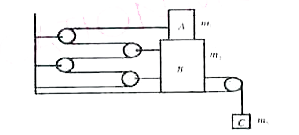
In the figure, `m _(1)= m _(2) =1kg,` The co-efficients of friction between A, B and B, surface are 0.2. The maximum value of `m_3` so that no block slips is nx7 the value of n is (All the pullies are ideal and strings are massless).

Text Solution

Verified by Experts

The correct Answer is:

2
Promotional Banner

Similar Questions

Explore conceptually related problems

In the figure masses m_(1),m_(2) and M are kg. 20 Kg, 5 kg and 50 kg respectively. The co-efficient of friction between M and ground is zero. The co-efficient of friction between m_(1) and M and that between m_(2) and ground is 0.3. The pulleys and the string are massless. The string is perfectly horizontal between P_(1) and m_(1) and also between P_(2) and m_(2). The string is perfectly verticle between P_(1) and P_(2). An externam horizontal force F is applied to the mass M. Take g=10m//s^(2). (i) Drew a free-body diagram for mass M, clearly showing all the forces. (ii) Let the magnitude of the force of friction between m_(1) and M be f_(1) and that between m,_(2) and ground be f_(2). For a particular F it is found that f_(1)=2f_(2). Find f_(1) and f_(2). Write down equations of motion of all the masses. Find F, tension in the string and accelerations of the masses.

In the figure m_(A) = m_(B) = m_(C) = 60 kg . The coefficient of friction between C and ground is 0.5 B and ground is 0.3, A and B is 0.4. C is pulling the string with the maximum possible force without moving. Then the tension in the string connected to A will be

Three blocks A , B and C , whose masses are 9kg , 9kg and 18kg respectively as shown in the figure, are released from rest. The co-efficient of friction between block A and the horizontal surface is 0.5 & the co-efficient of friction between block B and the horizontal surface is 0.5 . Find the acceleration of block C just release [Take g=10m//s^(2) ]. All strings and pulleys are ideal

Two blocks a and B of mass m_(A)=1kg and m_(B)=3kg are kept on the table as shown in figure the coefficient of friction between A and B is 0.2 and between B and the surface of the table is also 0.2 the maximum force F that can be applied on B horizontally, so that the block A does not slide over the block B is [Take g=10m//s^(2) ]

There are two block as shown in the figure of masses 1kg and 4kg . Friction coefficient between any two surfaces are 0.2 then find maximum value of horizontal force F so that both blocks moves together.

There block A B ,and C of equal mass m are placed one over the other on a frictionless surface (table) as shown in figure The coefficient of friction between any blocks A ,B and C is mu The maximum value of mass of block D so that the blocks A,B and C move without slipping over each other is

The coefficient of static friction, mu_(s) between block A mass 2kg and the table as shown in the figure, is 0.2. What would be the maximum mass value of block B, so that the two blocks do not move ? The string and the pulley are asseumed to be smooth and massless ( g=10m//s^(2) )

Two block tied with a massless string of length 3m are placed on a rotating table as shown. The axis of rotation is 1m from 1kg mass and 2m from 2kg mass. The angular speed omega=4rad//s . Ground below 2kg block is smooth and below 1kg block is rough. (g=10m//s^(2)) (a) Find tension in the string, force of friction on 1kg block and its direction. (b) If coefficient of friction between 1kg block and groung is mu=0.8 . Find maximum angular speed so that neither of the blocksd slips. (c) If maximum tension in the string can be 100N , then maximum angular speed so that neither of the blocks slips.

In the figure shown co-efficient of friction between the block B and C is 0.4. There is no friction between the block C and hte surface on which it is placed. The system of blocks is released from rest in the shown situation. Find the distance moved by the block C when block A descends through a distance 2m. Given masses of the blocks are m_(A)=3 kg, m_(B)=5 kg and m_(C)=10 kg .

The coefficient of static friction between the block of 2 kg and the table shown in figurwe is mu_s=0.2 What should be the maximum value of m so tht the blocks do not move? Take g=10 m/s^2. The string and the pulley are light and smooth.
