Home
Class 11
PHYSICS
A long block B rests on a smooth horizon...

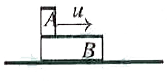
A long block B rests on a smooth horizontal plane. A small block A of mass half that of B is placed at one end of B and given a horizontal velocity u. If `mu` is the co-efficient of friction between the two blocks, then the time elapsed before the two blocks attain a common velocity is `( 2u)/( n mug)` wher n is

Text Solution

Verified by Experts

The correct Answer is:

2
Promotional Banner

Similar Questions

Explore conceptually related problems

A long block A is at rest on a smooth horizontal surface. A small block B whose mass is half of mass of A is placed on A at one end and is given an initial velocity u as shown in figure. The coefficient of friction between the blocks is mu .

A long block A is at rest on a smooth horizontal surface. A small block B, whose mass is half of A, is placed on A at one end and projected along A with some velocity u. The coefficient of friction between the blocks is mu :

A long block A of mass M is at rest on a smooth horizontal surface.A small block B of mass M//2 is placed on A at one end and projected along A with some veklocity v.The coefficient of friction between the block is mu then , the accelerations of blocks A and B before reaching a common velocity will be respectively

A block of mass m is placed at rest on an inclination theta to the horizontal. If the coefficient of friction between the block and the plane is mu , then the total force the inclined plane exerts on the block is

A block B is pushed momentarily along a horizontal surface with an initial velocity v . If mu is the coefficient of sliding friction between B and the surface, block B will come to rest after a time:

A block B is pushed momentarily along a horizontal surface with an initial velocity v . If mu is the coefficient of sliding friction between B and the surface, block B will come to rest after a time:

A block of mass 2kg rests on a rough inclined plane making an angle of 30^@ with the horizontal. The coefficient of static friction between the block and the plane is 0.7. The frictional force on the block is

A block of mass 2kg rests on a rough inclined plane making an angle of 30^@ with the horizontal. The coefficient of static friction between the block and the plane is 0.7. The frictional force on the block is

A block of mass m is pulled by a force of constant power P placed on a rough horizontal plane. The friction coefficient between the block and the surface is mu . Then

On a smooth table two blocks of masses 2.5kg and 1.5kg are placed one over the other as shown in figure. If the coefficient of static friction between two blocks is 0.2, the maximum horizontal force to be applied on the lower block so that the two blocks move together is (g = ms^(-2) )
