Home
Class 11
PHYSICS
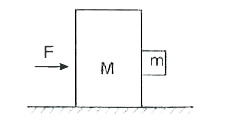
A horizontal force F pushes wedge of mas...

A horizontal force F pushes wedge of mass M on a smooth horizontal surface. A block of mass m is stationary to the wedge, then:

A

Frictional force is equal to mg between M and m

B

Minimum coefficient of friction between M and m is `(M +m) (g)/(F)`

C

Minimum force required to prevent related sliding between M and m is `(M +m) (g)/(mu)`

D

The reaction between M and m is `(mF)/(M +m)`

Text Solution

Verified by Experts

The correct Answer is:

A, B, C, D
Promotional Banner

Similar Questions

Explore conceptually related problems

In the given figure, the wedge is acted upon by a constant horizontal force F. The wedge is moving on a smooth horizontal surface. A ball of mass 'm' is at rest relative to the wedge. The ratio of forces exerted on 'm' by the wedge when F is acting, and when F is withdrawn, assuming no friction between the wedge and the ball, the ratio is equal to

In the given figure, the wedge is acted upon by a constant horizontal force 'F'. The wedge is moving on a smooth horizontal surface. A ball of mass 'm' is at rest relative to the wedge. The ratio of forces exerted on 'm' by the wedge when 'F' is acting and 'F' is withdrawn assuming no friction between the edge and the ball, is equal to :

A smooth wedge of mass M rests on a smooth horizontal surface. A block of mass m is projected from its lowermost point with velocity v_(0) . What is the maximum height reached by the block?

A smooth wedge of mass M rests on a smooth horizontal surface. A block of mass m is projected from its lowermost point with velocity v_(0) . What is the maximum height reached by the block?

A wedge shaped block A' of mass M is at rest on a smooth horizontal surface. A small block 'B' of mass 'm' placed at the top edge of inclined plane of length 'l' as shown in the figure. By the time, the block 'B' reaches the bottom end, the wedge A moves a distance of:

A block of mass m is placed at rest on a smooth wedge of mass M placed at rest on a smooth horizontal surface. As the system is released

A wedge B of mass 2 m is placed on a rough horizontal suface. The coefficient of friction between wedge and the horizontal surface is mu_(1) . A block of mass m is placed on wedge as shown in the figure. The coefficient of friction between block and wedge is mu_(2) . The block and wedge are released from rest. Q. Suppose the inclined surface of the wedge is at theta=37^(@) angle from horizontal and mu_(2)=0.9 then the wedge:

A wedge B of mass 2 m is placed on a rough horizontal suface. The coefficient of friction between wedge and the horizontal surface is mu_(1) . A block of mass m is placed on wedge as shown in the figure. The coefficient of friction between block and wedge is mu_(2) . The block and wedge are released from rest. Q. Suppose the inclined surface of the wedge is at theta=37^(@) from angle from horizontal and mu_(2)=0 are wedge will remain in equilibrium if

A horizontal force F acts on a wedge of mass m_1 as shown. A block of mass is placed on the front wall of my. Assuming all contact surfaces to be smooth and m_2 moves on a smooth horizontal surface.

A small ball ( uniform solid sphere ) of mass m is released from the top of a wedge of the same mass m . The wedge is free to move on a smooth horizontal surface. The ball rolld without sliding on the wedge. The required height of the wedge are mentioned in the figure. The total kinetic energy of the ball just before it falls on the ground
