Home
Class 11
PHYSICS
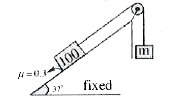
The minimum value of mass m for which th...

The minimum value of mass m for which the 100 kg block can remain in static equilibrium is

A

35 kg

B

36 kg

C

93 kg

D

`3.25` kg

Text Solution

Verified by Experts

The correct Answer is:

B
Promotional Banner

Similar Questions

Explore conceptually related problems

Which maintains static equilibrium-

Two blocks A and B are connected by a string as shown as shown in the figure . Friction coefficient of the inclined plane is 0.5 . The mass of the block A is 5 kg. If minimum and maximum values of mass of the block B for which the block A remains in equilibrium are m_(1) and m_(2) then find the value of (m_(2) - m_(1)) [in kg]

A block of mass m is supported on a rough wall by applying a force in figure Coefficient of static friction between block and wall is mu For what range of value of p , the block remain in static equilibrium ?

A block of mass m lying on a rough horizontal plane is acted upon by a horizontal force P and another force Q inclined at an angle theta to the vertical. The minimum value of coefficient of friction of friction between the block and the surface for which the block will remain in equilibrium is

A block of mass m lying on a rough horizontal plane is acted upon by a horizontal force P and another force Q inclined at an angle theta to the vertical. The minimum value of coefficient of friction of friction between the block and the surface for which the block will remain in equilibrium is

A block of mass m lying on a rough horizontal plane is acted upon by a horizontal force P and another force Q inclined at an angle theta to the vertical. The minimum value of coefficient of friction of friction between the block and the surface for which the block will remain in equilibrium is

A block of mass m collides with another block of mass 3m completely inelastically as shown in figure. What is the maximum value of v ( in m//s) for which the block B does not move. Assume that initially spring is in natural length and blocks A and B are at rest. (K//m=100 S.I. unit )

A block of mass m is pushed towards a movable wedge of mass nm and height h , with a velocity u . All surfaces are smooth. The minimum value of u for which the block will reach the top of the wedge is

The figure an L shaped body of mass M placed on smooth horizontal surface. The block A is connected to the body by means of an inexiensible string , which is passing over a smooth pulley of negligible mass.Another block B of mass m is placed against a vertical wall of the body. Find the minimum value of the mass of block A so that B remain stationary relative to the wall. Coefficient of friction between the block B and the vertical wall is mu .

Two identical blocks 'A' and 'B' each of mass 5kg are connected with an ideal string and placed on a rough horizontal table having coefficient of friction (mu = 0.4 ) third block of mass 'm' are connected to block 'B' with another ideal string which is passing over a ideal pully as shown in figure.The minimum value of mass of block 'C' such that blocks just starts moving is (g= 10 m/ s^2 )
