Home
Class 11
PHYSICS
A small block of mass 1kg is placed over...

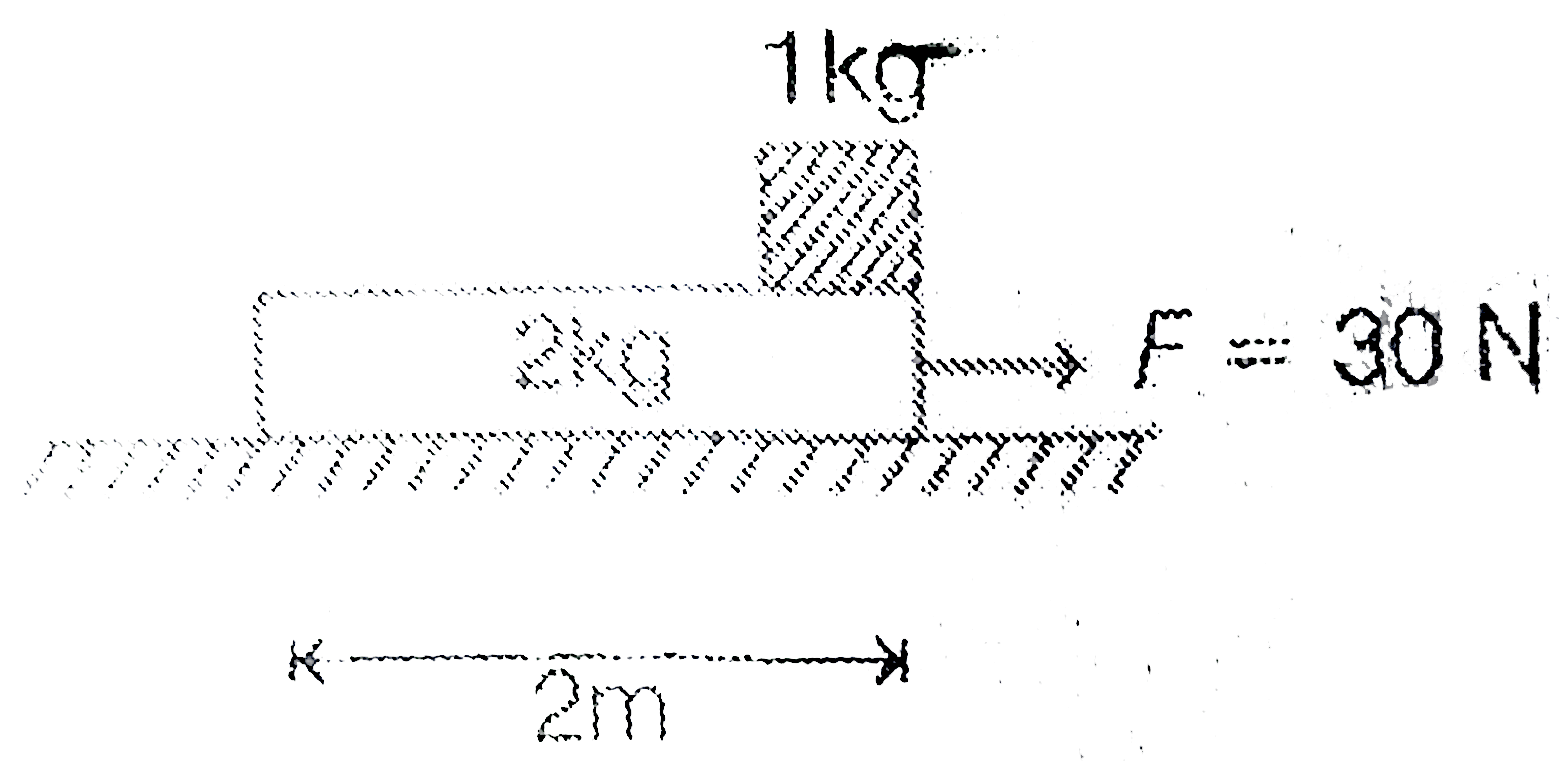
A small block of mass 1kg is placed over a plank of mass 2kg. The length of the plank is 2 m. coefficient of friction between the block and the plnak is 0.5 and the ground over which plank in placed is smooth. A constant force F=30N is applied on the plank in horizontal direction. the time after which the block will separte from the plank is `(g=10m//s^(2))`

Text Solution

Verified by Experts

The correct Answer is:

2
Promotional Banner

Similar Questions

Explore conceptually related problems

A plank of mass 2 kg and length 1 m is placed on horizontal floor.A small block of mass 1 kg is placed on top of the plank , at its right extreme end .The coefficient of friction between plank and floor is 0.5 and that between plank and block is 0.2 . If a horizontal force = 30 N starts acting on the plank to the right ,the time after which the block will fall off the plank is (g = 10 ms^(-2))

A bolck of mass m =2 kg is placed on a plank of mass M = 10 kg, which is placed on a smooth horizontal plane as shown in the figure. The coefficient of friction between the block and the plank is mu=(1)/(3) . If a horizontal force F is applied on the plank, then the maximum value of F for which the block and the plank move together is (g=10m//s^(2))

A block of mass m=2kg of shown dimensions is placed on a plank of mass M = 6Kg which is placed on smooth horizontal plane. The coefficient of friction between the block and the plank is mu=1/3 . If a horizontal froce F is applied on the plank, then find the maximum value of F (in N) for which the block and the plank move together

A block of mass 2 kg slides down an incline plane of inclination 30°. The coefficient of friction between block and plane is 0.5. The contact force between block and plank is :

A plank of mass 10 kg and a block of mass 2 kg are placed on a horizontal plane as shown in the figure. There is no friction between plane and plank. The coefficient of friction between block and plank is 0.5 .A force of 60 N is applied on plank horizontally. In first 2 s the work done by friction on the block is

A block of mass'm' it kept over the smooth surface of the plank of mass M. the plank of length l is kept over the smooth horizontal surface. A constant horizontal force F is applied onto the plank as shown in figure. Calculate the time after which the block falls off the plank?

A block of mass m is gently placed over a massive plank moving horizontal over a smooth surface with velocity 10 ms^(-1) . The coefficient of friction between the block and the plank is 0.2. The distance travelled by the block till it slides on the plank is [g = 10 ms^(-2)]

A plank A of mass M rests on a smooth horizontal surface over which it can move without friction A cabe B of mass m lies on the plank at one edge .The coefficient of friction between the plank and the cube is mu The size of cube is very small in comparison to the plank. At what force F applied to the plank in the horizontal direction will be cube begin to slide towards the other end of the plank?

A block A of mass 2 kg is placed over smooth block B of mass 4 kg which is placed over a smooth horizontal floor The coefficient of friction between A and B is 0.4 when a horizontal forces of magnitude 10 N is applied on A the acceleration of block of A and B are

A 2kg block is placed over a 5kg block and both are placed on a smooth horizontal surface. The coefficient of friction between the blocks is 0.10. Find the acceleration of the two blocks if a horizontal force of 14N is applied to the upper block (g = 10ms^(-2) ).
