Home
Class 11
PHYSICS
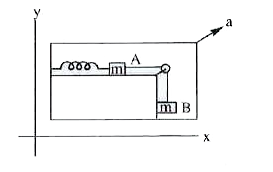
The arrangement shown in the diagram is ...

The arrangement shown in the diagram is moving in a space with an acceleration `a = 4 (hati + hatj) ml s ^(2).` An ideal spring of natural length `l_(0)` having spring constant K = 50N/m, is connected to the block A. Blocks A and B are conected by an ideal string passing through a frictionless pulley. Mass of each block A and B is equal to m = 2kg. The minimum value of coefficient of friction so that spring remains in its natural length is 5/n where n is.

Text Solution

Verified by Experts

The correct Answer is:

9
Promotional Banner

Similar Questions

Explore conceptually related problems

The arrangement shown in figure is at rest. An ideal spring of natural length l_0 having spring constant k=220Nm^-1 , is connected to block A. Blocks A and B are connected by an ideal string passing through a friction less pulley. The mass of each block A and B is equal to m=2kg when the spring was in natural length, the whole system is given an acceleration veca as shown. If coefficient of friction of both surfaces is mu=0.25 , then find the maximum extension in 10(m) of the spring. (g=10ms^-2) .

Two blocks of masses m_(1) and m_(2)(m_(1) gt m_(2)) connected by a massless string passing over a frictionless pulley Magnitude of acceleration of blocks would be

Two blocks are connected by a cord passing over a small frictionless pulley and resting on frictionless planes as shown in the figure. The acceleration of the blocks is :

Two blocks, each having mass m, are connected with an ideal string through ideal pulleys on a frictionless fixed wedge as shown in the figure. The acceleration of the blocks is

In the figure all spring are identical having spring constant k and mass m each The block also mass m The frequency of oscillation of the block is

The figure shows two blocks of mass m each, connected by an ideal unstretched spring and then placed on a frictionless floor. If the blocks are given velocities v_(0) and 2v_(0) as shown, then the maximum extension in the spring is

Two blocks of masses m and m' are connected by a light spring on a horizontal frictionless table . The spring is compressed and then released . Find the ratio of acceleration of masses .

Two blocks are connected by a long inextensible string passing over an ideal pulley as shown in the figure. If the system is released from rest then the common speed of blocks when block m_2 moves a distance I will be

Two blocks of masses m and 2m are connected by a light string passing over a frictionless pulley. As shown in the figure, the mass m is placed on a smooth inclined plane of inclination 30° and 2m hangs vertically. If the system is released, the blocks move with an acceleration equal to :

A block Q of mass 2m is placed on a horizontal frictionless plane. A second block of mass m is placed on it and is connected to a spring of spring constant K, the two block are pulled by distance A. Block Q oscillates without slipping. The work done by the friction force on block Q when the spring regains its natural length is:
