Home
Class 11
PHYSICS
A particle is resting on an inverted con...

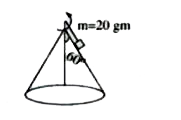
A particle is resting on an inverted cone as shown. It is attached to cone by a thread of length 20 cm. String remains parallel to slope of cone. The cone is given angular acceleration of `0.5 rad//sec^(2)` then at what time does mass leave contact with surface (assuming sufficient friction):

A

20 sec

B

10 sec

C

40 sec

D

5 sec

Text Solution

Verified by Experts

The correct Answer is:

A
Promotional Banner

Similar Questions

Explore conceptually related problems

A coin is placed on the horizontal surface of a rotation disc. The distance of the coin from the axis is 1 m and coefficient of friction is 0.5. If the disc starts from rest and is given an angular acceleration (1)/(sqrt(2)) rad / sec^(2) , the number of revolutions through which the disc turns before the coin slips is

A block of mass m height 2h and width 2b rests on a flat car which moves horizontally with constant acceleration a as shown in figure. Determine a. the value of the acceleration at which slipping of the block on the car starts, if the coefficient of friction is mu . b. the value of the acceleration at which block topples about A , assuming sufficient friction to prevet slipping and c. the shortest distance in which it can be stopped from a speed of 20 ms^(-1) with constant deceleration so that the block is not disturbed. The following data are given b=0.6 m, h=0.9m, mu=0.5 and g=10ms^(-2)

A small coin of mass 80g is placed on the horizontal surface of a rotating disc. The disc starts from rest and is given a constant angular acceleration alpha=2rad//s^(2) . The coefficient of static friction between the coin and the disc is mu_(s)=3//4 and cofficient of kinetic friction is mu_(k)=0.5 . The coin is placed at a distance r=1m from the centre of the disc. The magnitude of the resultant force on the coin exerted by the disc just before it starts slipping on the disc is

A small coin of mass 80g is placed on the horizontal surface of a rotating disc. The disc starts from rest and is given a constant angular acceleration alpha=2rad//s^(2) . The coefficient of static friction between the coin and the disc is mu_(s)=3//4 and cofficient of kinetic friction is mu_(k)=0.5 . The coin is placed at a distance r=1m from the centre of the disc. The magnitude of the resultant force on the coin exerted by the disc just before it starts slipping on the disc is

A particle of mass m and charge Q is attached to a string of length l. It is whirled in a vertical circle in the region of an electric field E as shown in the figure-5.105.What is the speed given to the particle at the point B,so that tension in the string when the particle is at A is ten times the weight of the particle?

A small coin of mass 40 g is placed on the horizontal surface of a rotating disc. The disc starts from rest and is given a constant angular acceleration alpha="2 rad s"^(-2) . The coefficient of static friction between the coin and the disc is mu_(s)=3//4 and the coefficient of kinetic friction is mu_(k)=0.5. The coin is placed at a distance r=1m from the centre of the disc. The magnitude of the resultant force on the coin exerted by the disc just before it starts slipping on the disc is?

A massless spring of stiffness 400 N/m is fastened at left end to a vertical wall as shown in the figure I. initially block C of mass 2 kg and block D of mass 5 kg rest on horizontal surface with block C in contact with spring (But not compressiong it.) and the block D in contact with block C block C is moved leftward compressing spring by a distance of 0.5 m and held in place while block D remains at rest as shown in the figure. Now block C is released and it accelerates to the right towards block D the surface is rough and the coefficient of friction between each block and surface is 0.1 The block collide Instantaneously stick together and move right find the velocity of combined system just after collision.

A small sized mass m is attached by a massless string (of length L ) to the top of a fixed frictionless solid cone whose axis is vertical. The half angle at the vertex of cone is theta. If the mass m moves around in a horizontal circle at speed v , what is the maximum value of v for which mass stay in contact with the comes? (g is acceleration due to gravity.)

A wheel of radius 10 cm can rotate freely about its centre as shown in figure. A string is wrapped over its rim and is pulled by a force of 5.0 N. It is found that the torque produces an angular acceleration 2.0 rad s^-2 in the wheel. Calculate the moment of inertia of the wheel.

The arrangement shown in figure is at rest. An ideal spring of natural length l_0 having spring constant k=220Nm^-1 , is connected to block A. Blocks A and B are connected by an ideal string passing through a friction less pulley. The mass of each block A and B is equal to m=2kg when the spring was in natural length, the whole system is given an acceleration veca as shown. If coefficient of friction of both surfaces is mu=0.25 , then find the maximum extension in 10(m) of the spring. (g=10ms^-2) .
