Home
Class 11
PHYSICS
A toy car of mass 'm' can travel at a fi...

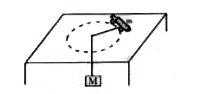
A toy car of mass 'm' can travel at a fixed speed. It moves in a circle on a fixed horizontal table. A string in connected to car and attached to a block of mass 'M' that hangs as shown in fig (The portion of string below the table is always vertical). The coefficient of friction between the surface of table and tyres of the toy car is '`mu`'. The ratio of maximum radius to minimum radius for which the toy car can move in a circular path with 'O' on table is `(r_("max"))/(r_("min"))= ((M+xmum))/((M-mum))` then the value of x is .........

Text Solution

Verified by Experts

The correct Answer is:

1
Promotional Banner

Similar Questions

Explore conceptually related problems

A car is taking a turn of radius 400 m on a horizontal circle . Coefficient of friction between the ground and tyres of car is 0.2 . Find the maximum speed with a safe turn can be taken

A car is moving along a straight horizontal road with a speed v_(0) . If the coefficient of friction between the tyres and the road is mu , the shortest distance in which the car can be stopped is

A homogoneous chain of length L lies on a table. The coefficient of friction between the chain and the table is mu . The maximum length which can hang over the table in equilibrium is

If coeffiecient of friction between the block of mass 2kg and table is 0.4 then out acceleration of the system and tension in the string. (g=10m//s^(2))

A body of mass 20kg is moving on a rough horizontal plane. A block of mass 3kg is connected to the 20 kg mass by a string of negligible mass through a smooth pulley as shown in the figure. The tension in the string is 27 N. The coefficient of kinetic friction between the heavier mass and the surface is (g = 10m/ s^2 )

A block of mass m is kept on horizontal turn table at x distance from the centre. If coefficient of friction between block and surface of turn table is mu , then maximum angular speed of the table so that block does not slip

A block of mass m kept on rough horizontal turn table at a distance x from the centre. If the coefficient of friction between the table and block is mu then maximum speed of point P on turn table so that the block does not slip is

The coefficient of static friction between the two blocks shown in figure is mu and the table is smooth. What maximum horizontal forced F can be applied to he block of mass M so that the block move together?

The coefficient of static friction between the two blocks shown in figure is mu and the table is smooth. What maximum horizontal forced F can be applied to he block of mass M so that the block move together?

In the figure shown, the coefficient of static friction between the block A of mass 20 kg and horizontal table is 0.2. What should be the minimum mass of hanging block just beyond which blocks start moving?
