Home
Class 11
PHYSICS
A small wedge whose base is horizontal i...

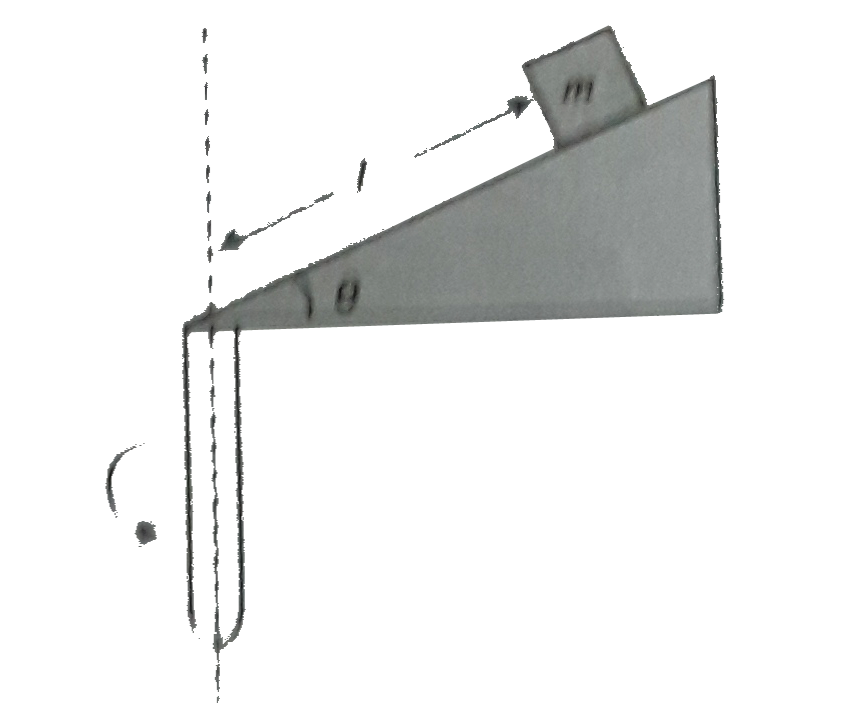
A small wedge whose base is horizontal is fixed to a vertical rod as shown in fig . The sloping side of the weidge is frictionless and the wedge is spin with a constant angular speed `omega` about vertical axis as shown in the fig find the
a. value of angular speed `omega ` for which the block of mass `m` just does not slide down the wedge.
b. normal reaction on the block by wedge when block does not slip relative to wedge.

Text Solution

Verified by Experts

The correct Answer is:

1
Promotional Banner

Similar Questions

Explore conceptually related problems

A block of mass m is placed at the top of a smooth wedge ABC. The wedge is rotated about an axis passing through C as shown in the figure - 3.81. The minimum value of angular speed omega such that the block does not slip on the wedge is :

The minimum value of acceleration of wedge for which the block start sliding on the wedge, is:

A vertical U -tube is spinned about the vertical axis passing through the left hand limb, with an angular speed omega such that the liquid columns in the limbs have heights h and 3h , as shown in the figure. Find the value of to omega .

A uniform rod of mass m and length l_(0) is rotating with a constant angular speed omega about a vertical axis passing through its point of suspension. Find the moment of inertia of the rod about the axis of rotation if it make an angle theta to the vertical (axis of rotation).

A smoothh disc is rotating with uniform angular speed omega about a fixed vertical axis passing through its centre and normal to its plane as shown. A small block of mass m is gently placed at the periphery of the disc. Then (pickup the correct alternative or alternatives)

In the arrangement shown in fig. the block of mass m=2kg lies on the wedge of mass M=8kg . The initial acceleration of the wedge, if the surfaces are smooth, is

Refer the system shown in the figure. Block is siding down the wedge. All surfaces are frictionless. Find correct statement (s)

A block is released on the convex surface of a hemispherical wedge as shown in Fig. Determine the displacement of the wedge when the block reaches the angular position theta

A wedge of mass m_2 is kept on a spring balance. A small block of mass m_1 can move along the frictionless incline of the wedge. What is the reading of the balance while the block slides? Ignore the recoil of the wedge.

A block of mass m is released from a wedge of mass m as shown in figure . Find the time taken by the block to reach the end of the wedge.
