Home
Class 11
PHYSICS
Three identical particles are joined tog...

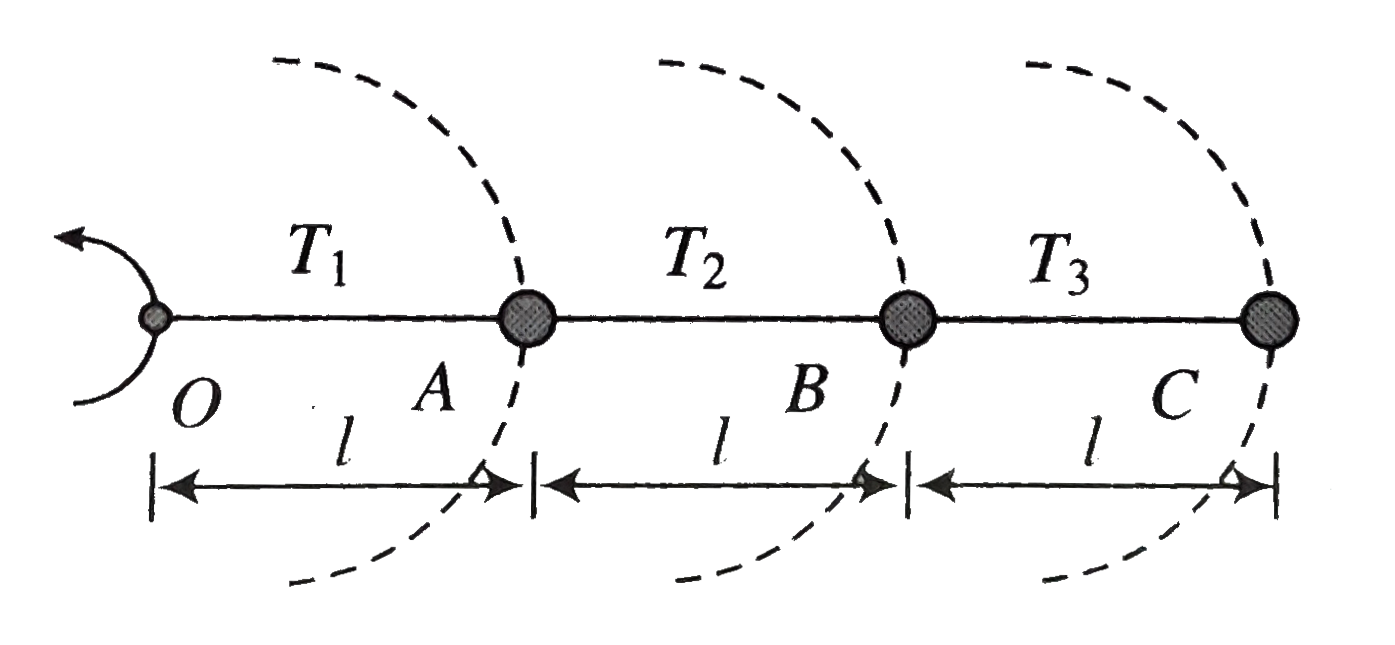
Three identical particles are joined together by a thread as shown in figure All the partical are moving in a horizontal plane If the vertical of the outermost particle is `v_(0)` then the ratio of tension in the three sections of the string `(T_(1):T_(2):T_(3) = ?)` is

A

3:5:7

B

3:4:5

C

7:11:6

D

3:5:6

Text Solution

Verified by Experts

The correct Answer is:

D
Promotional Banner

Similar Questions

Explore conceptually related problems

Three identical particles are joined together by a thread as shown in figure. All the three particles are moving in a horizontal plane. If the velocity of the outermost particle is v_(0) , then the ratio of tensions in the three sections of the string is (T_(BC):T_(AB):T_(DA))

In the arrangment shown in the figure, the ratio of tensions T_(1): T_(2) : T_(3) is:

Two particles each of mass m are moving in horizontal circle with same angular speed. If both string are of same length then the ratio of tension in string (T_(1))/(T_(2)) is

Acceleration of two identical particles moving in a straight line are as shown in figure. The corresponding a-t graph of their centre of mass will be

A particle of mass m is tied to a string of length L and whirled into a horizontal plan. If tension in the string is T then the speed of the particle will be :

A rod AB of mass m is hung by two ideal threads. Find the ratio of tensions in the two threads ((T_(1))/(T_(2))) .

The x-t graph of a particle moving along a straight line is shown in figure The v-t graph of the particle is correctly shown by

The x-t graph of a particle moving along a straight line is shown in figure The a-t graph of the particle is correctly shown by

The velocity-time graph of a particle moving in a straight line is shown in figure. The mass of the particle is 2kg . Work done by all the forces acting on the particle in time interval between t=0 to t=10s is

A horizontal plane supports a fixed vertical cylinder of radius R and a particle is attached to the cylinder by a horizontal thread AB as shown in Fig. The particle initially rest on a horizontal plane. A horizontal velocity v_(0) is imparted to the particle, normal to the threading during subsequent motion. Point out the false statements:
