Home
Class 11
PHYSICS
As shown below AB represents an infinite...

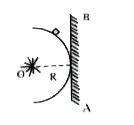
As shown below AB represents an infinite wall tangential to a horizontal semi-circular track. O is a point source of light on the ground at the center of the circle. A block moves along the circular track with a speed v starting from the point where the wall touches the circle. If the velocity and acceleration of shadow along the length of the wall is respectively v and a, then:

A

`V= vcos((vt)/(R))`

B

`V= vsec^(2)((vt)/(R))`

C

`a= ((v^(2))/(R))sec^(2)((vt)/(R))tan((vt)/(R))`

D

`a= ((2v^(2))/(R))sec^(2)((vt)/(R))tan((vt)/(R))`

Text Solution

Verified by Experts

The correct Answer is:

B, D
Promotional Banner

Similar Questions

Explore conceptually related problems

On a particle moving on a circular path with constant speed v , light is thrown from a projectors placed at the centre of the circular path. The shadow of the particle is formed on the wall. The velocity of shadow up the wall is

A block of mass m is projected on a smooth horizontal circular track with velocity v what is the average normal force exered by the circular walls on the block during motion A to B?

A point moves along a circle with a speed v=kt , where K=0.5m//s^(2) Find the total acceleration of the point the momenet when it has covered the n^(th) Fraction of the circle after the beginging of motion, where n=(1)/(10) .

A truck has to move to a dimetrically opposite point on a circular track which surrounds a field. The speed of the truck along the track is 2v_(0) . While that in the field is v_(0) . The driver plans to move along an arc of a circle and then along a straight line as shown.

A block of mass m is placed on a vertical fixed circular track and then it is given velocity v along the track at position A on track. The coefficient of friction between the block and the track varies with the angle theta . If the block moves on track with constant speed then the coefficient of friction is

A point object moves along an arc of a circle of radius 'R'. Its velocity depends upon the distance covered 'S' as V = Ksqrt(S) where 'K' is a constant. If ' theta' is the angle between the total acceleration and tangential acceleration, then

A rod AB is moving on a fixed circle of radius R with constant velocity 'v' as shown in figure. P is the point of intersection of the rod and the circle. At an instant the rod is at a distance x=(3R)/(5) from centre of the circle. The velocity of the rod is perpendicular to the rod and the rod is always parallel to the diameter CD . (a) Find the speed of point of intersection P (b) Find the angular speed of point of intersection P with respect to centre of the circle.

A rod AB is moving on a fixed circle of radius R with constant velocity v as shown in figure. P is the point of intersection of the rod and the circle. At an instant the rod is at a distance x=(3R)/(5) from centre of the circle. The velocity of the rod is perpendicular to the rod and the rod is always parallel to the diameter CD. (i) Find the speed of point of intersection P. (b) Find the angular speed of point of intersection P with respect to centre of the circle.

A car is moving along a circular track with tangential acceleration of magnitude a_(0) . It just start to slip at speed v_(0) then find radius of circle (Coeffecient of friction is mu ) ?

A block is mass m moves on as horizontal circle against the wall of a cylindrical room of radius R. The floor of the room on which the block moves is smooth but the friction coefficient between the wall and the block is mu . The block is given an initial speed v_0 . As a function of the speed v write a. the normal force by the wall on the block. b. the frictional force by the wall and c. the tangential acceleration of the block. d. Integrate the tangential acceleration ((dv)/(dt)=v(dv)/(ds)) to obtain the speed of the block after one revoluton.
