Home
Class 11
PHYSICS
The figure shows the variation of potent...

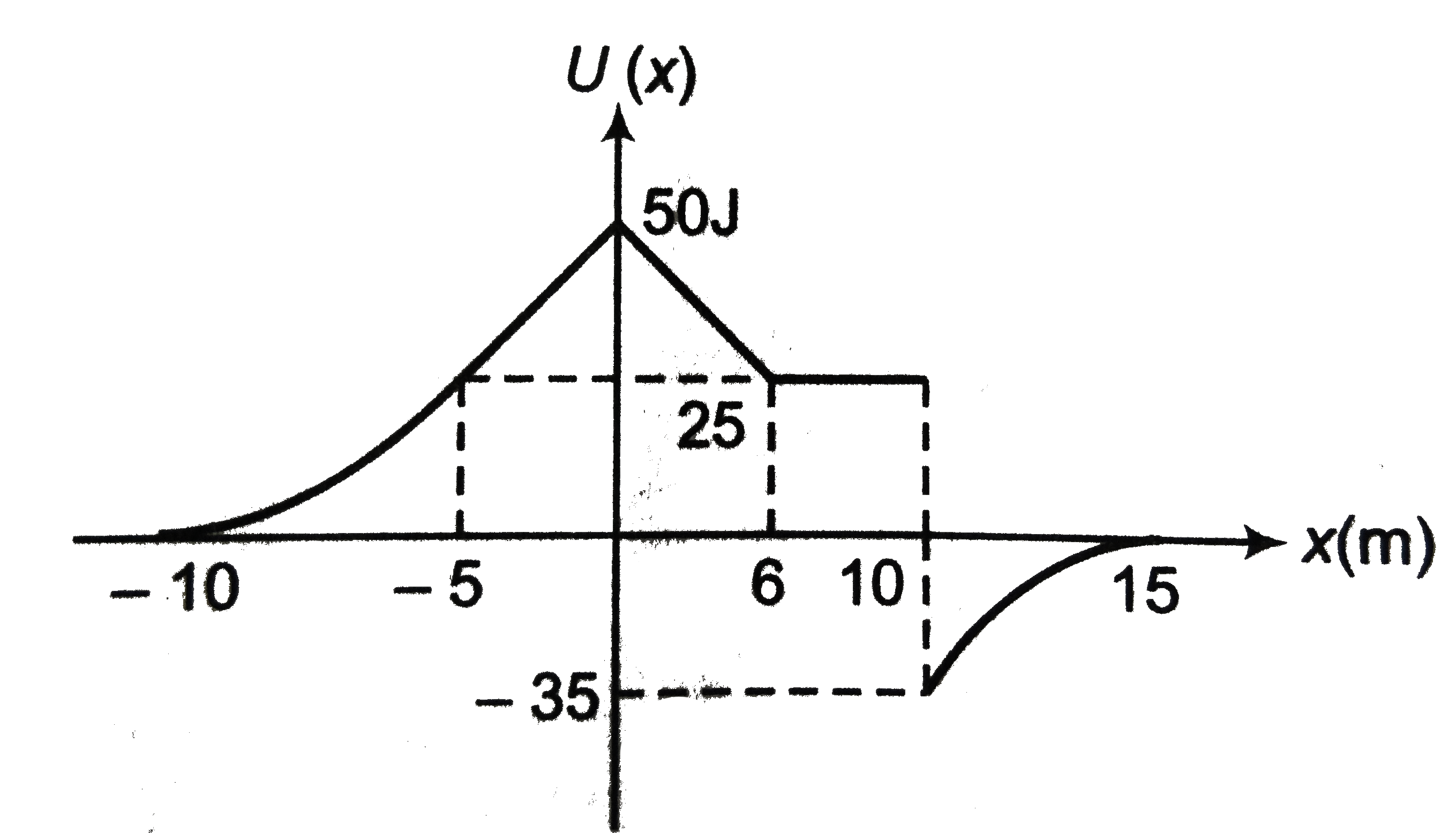
The figure shows the variation of potential energy of a particle as a funcation of x, the x-coordinate of the region. It has been assumed that potential energy depends only on `x`. For all other values `x, U` is zero. i.e. for` x lt - 10` and `x gt 15, U = 0`.

If total mechanical energy of the particle is `-40J`, then it can be found in region.

A

`xlt-10` and `xgt15`

B

can be found in region

C

`10ltxlt15`

D

It is not possible

Text Solution

Verified by Experts

The correct Answer is:

D
Promotional Banner

Similar Questions

Explore conceptually related problems

The figure shows the variation of potential energy of a particle as a function pf x, the x-coordination of the region. It has been assumed that potential energy depends only on x . For all other values x, U is zero. i.e. for x lt - 10 and x gt 15, U = 0 . If total mechanical energy of the particle is 25J , then it can found in the region

Figure shows the variation of potential energy of a particle as a function of x, the x-coordinate of the region. It has been assumed that potential energy depends only on x. For all other values of x, U is zero, i.e., xlarr10 and xgt15 , U=0 . If the particle is isolated and its total mechanical energy is 60J , then

The given plot shows the variation of U, the potential energy of interaction between two particles with the distance separating them r,

The given plot shows the variation of U, the potential energy of interaction between two particles with the distance separating them r,

Potential energy curve U of a particle as function of the position of a particle is shown. The particle has total mechanical energy E of 3.0 joules. Then select correct alternative.

The variation of potential energy of a particle of mass m = 5kg to its x-coordinate . The particle moves under the effect of this conservative force only along the x-axis. Then, choose the correct option.

The potential energy of a particle of mass m is given by U=(1)/(2)kx^(2) for x lt 0 and U = 0 for x ge 0 . If total mechanical energy of the particle is E. Then its speed at x = sqrt((2E)/(k)) is

Potential energy of a particle is related to x coordinate by equation x^2 - 2x . Particle will be in stable equilibrium at :

The potential energy U between two molecules as a function of the distance X between them has been shown in the figure. The two molecules are

The potential energy U between two molecules as a function of the distance X between them has been shown in the figure. The two molecules are
