Home
Class 11
PHYSICS
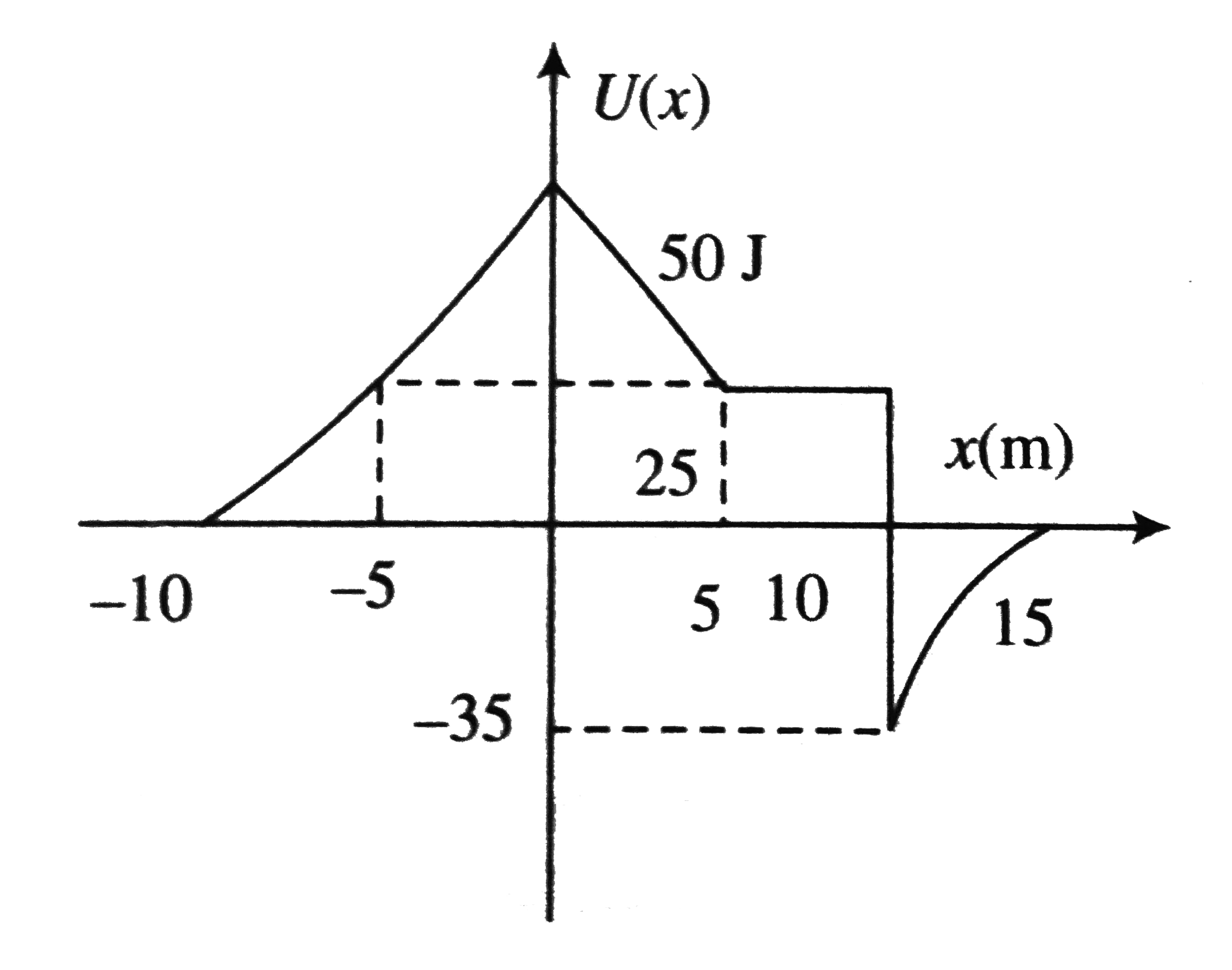
Figure shows the variation of potential ...

Figure shows the variation of potential energy of a particle as a function of x, the x-coordinate of the region. It has been assumed that potential energy depends only on x. For all other values of x, U is zero, i.e., `xlarr10` and `xgt15`, `U=0`.

If the particle is isolated and its total mechanical energy is `60J`, then

A

the particle can be found anywhere from `-ooltxltoo`

B

the particle's maximum KE is 95 J

C

the particle 's KE is not getting zero anywhere onX-axis

D

all of the above are true

Text Solution

Verified by Experts

The correct Answer is:

D
Promotional Banner

Similar Questions

Explore conceptually related problems

The figure shows the variation of potential energy of a particle as a funcation of x, the x-coordinate of the region. It has been assumed that potential energy depends only on x . For all other values x, U is zero. i.e. for x lt - 10 and x gt 15, U = 0 . If total mechanical energy of the particle is -40J , then it can be found in region.

The figure shows the variation of potential energy of a particle as a function pf x, the x-coordination of the region. It has been assumed that potential energy depends only on x . For all other values x, U is zero. i.e. for x lt - 10 and x gt 15, U = 0 . If total mechanical energy of the particle is 25J , then it can found in the region

Potential energy curve U of a particle as function of the position of a particle is shown. The particle has total mechanical energy E of 3.0 joules. Then select correct alternative.

The variation of potential energy of a particle of mass m = 5kg to its x-coordinate . The particle moves under the effect of this conservative force only along the x-axis. Then, choose the correct option.

Potential energy of a particle is related to x coordinate by equation x^2 - 2x . Particle will be in stable equilibrium at :

The potential energy U between two molecules as a function of the distance X between them has been shown in the figure. The two molecules are

The potential energy U between two molecules as a function of the distance X between them has been shown in the figure. The two molecules are

The potential energy of a particle varies with position X according to the relation U(x) = [(X^3/3)-(3X^2/2)+2X] then

Figure shows a plot of the potential energy as a function of x for a particle moving along the x-axis. Which of the following statement(s) is/are true?

Figure shows a plot of the potential energy as a function of x for a particle moving along the x-axis. Which of the following statement(s) is/are true?
