Home
Class 11
PHYSICS
A particle A of mass 10//7kg is moving i...

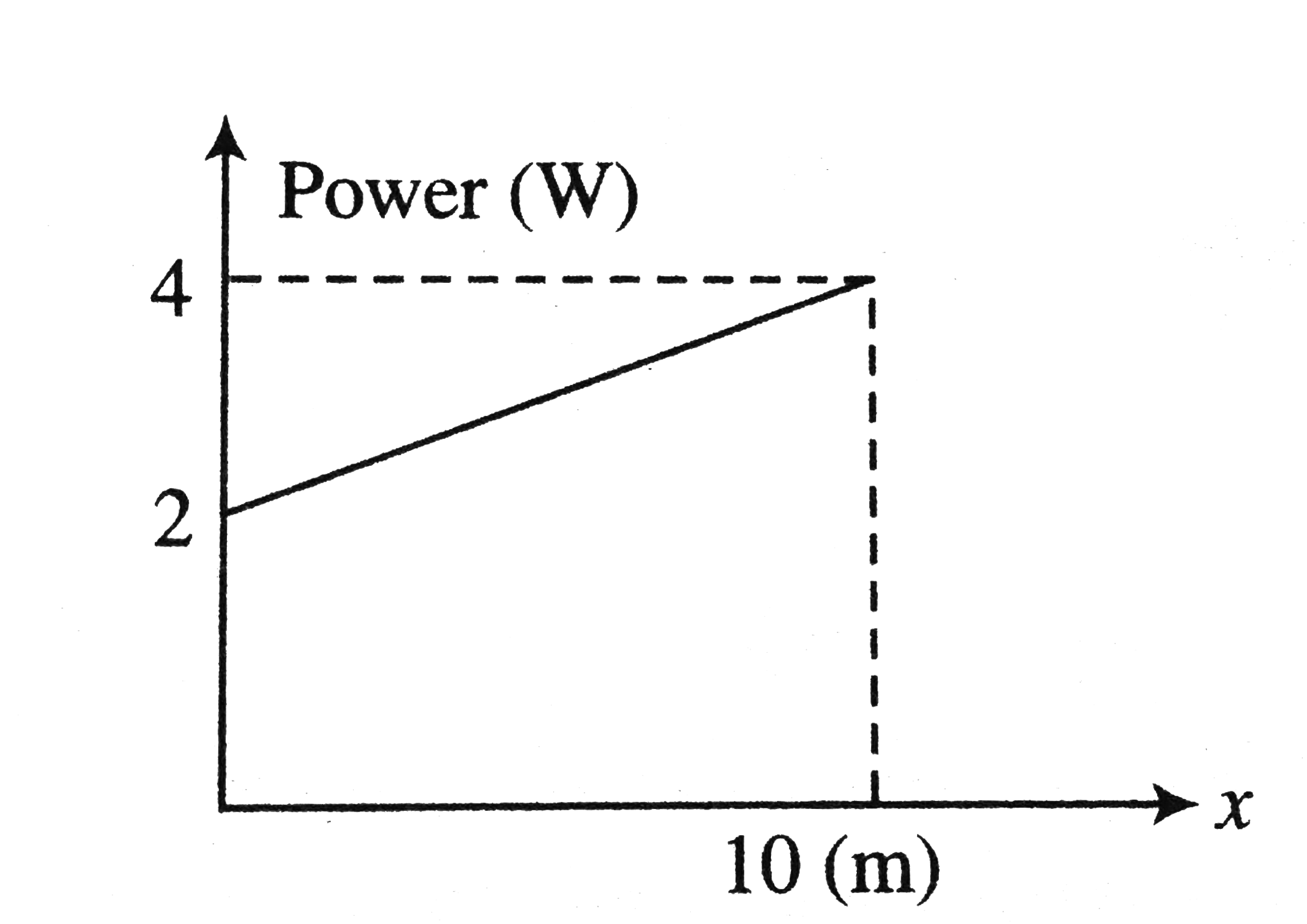
A particle A of mass `10//7kg` is moving in the positive direction of `x-axis`. At initial position `x=0`, its velocity is `1ms^-1`, then its velocity at `x=10m` is (use the graph given)

Text Solution

Verified by Experts

The correct Answer is:

4
Promotional Banner

Similar Questions

Explore conceptually related problems

A particle of mass 10^-2kg is moving along the positive x axis under the influence of a force F(x)=-K//(2x^2) where K=10^-2Nm^2 . At time t=0 it is at x=1.0m and its velocity is v=0 . (a) Find its velocity when it reaches x=0.50m . (b) Find the time at which it reaches x=0.25m .

The velocity of a particle moving in the positive direction of x-axis veries as v=10sqrtx . Assuming that at t=0 , particle was at x=0

A particle of mass 10^31 kg is moving with a velocity equal to 10^5ms^-1 . The wavelength of the particle is equal to

A particle moving in the positive x-direction has initial velocity v_(0) . The particle undergoes retardation kv^(2) , where vis its instantaneous velocity. The velocity of the particle as a function of time is given by:

A particle of mass m_1 moving with velocity v in a positive direction collides elastically with a mass m_(2) moving in opposite direction also at velocity v. If m_(2)gt gtm_(1) , then

A particle is moving along x-direction with a constant acceleration a. The particle starts from x=x_0 position with initial velocity u. We can define the position of the particle with time by the relation x=x_0+ut+(1)/(2)at^2 plot the position of the particle in relation with time is following situations (i) If initial position of the particle is on negativ x-axis, initial velocity is positive and acceleration is negative. (ii) If initial position is positive, initial velocity is negative and acceleration is positive.

The velocity of a particle moving in the positive direction of the X-axis varies as V = KsqrtS where K is a positive constant. Draw V-t graph.

Comprehension # 5 One particle of mass 1 kg is moving along positive x-axis with velocity 3 m//s . Another particle of mass 2 kg is moving along y-axis with 6 m//s . At time t = 0, 1 kg mass is at (3m, 0) and 2 kg at (0, 9m), x - y plane is the horizontal plane. (Surface is smooth for question 1 and rough for question 2 and 3) The centre of mass of the two particles is moving in a straight line for which equation is :

A particle of mass m is moving along the x-axis with initial velocity ui . It collides elastically with a particle of mass 10 m at rest and then moves with half its initial kinetic energy (see figure).If sin theta _(1) = sqrt(n) sin theta_(2) then value of n is

Comprehension # 5 One particle of mass 1 kg is moving along positive x-axis with velocity 3 m//s . Another particle of mass 2 kg is moving along y-axis with 6 m//s . At time t = 0, 1 kg mass is at (3m, 0) and 2 kg at (0, 9m), x - y plane is the horizontal plane. (Surface is rough for question, if cofficient of friction is 0.2 in both axis) Co-ordinates of center of mass where it will stop finally are :-
