Home
Class 11
PHYSICS
Two masses m(1) =10 Kg and m(2)=5kg are ...

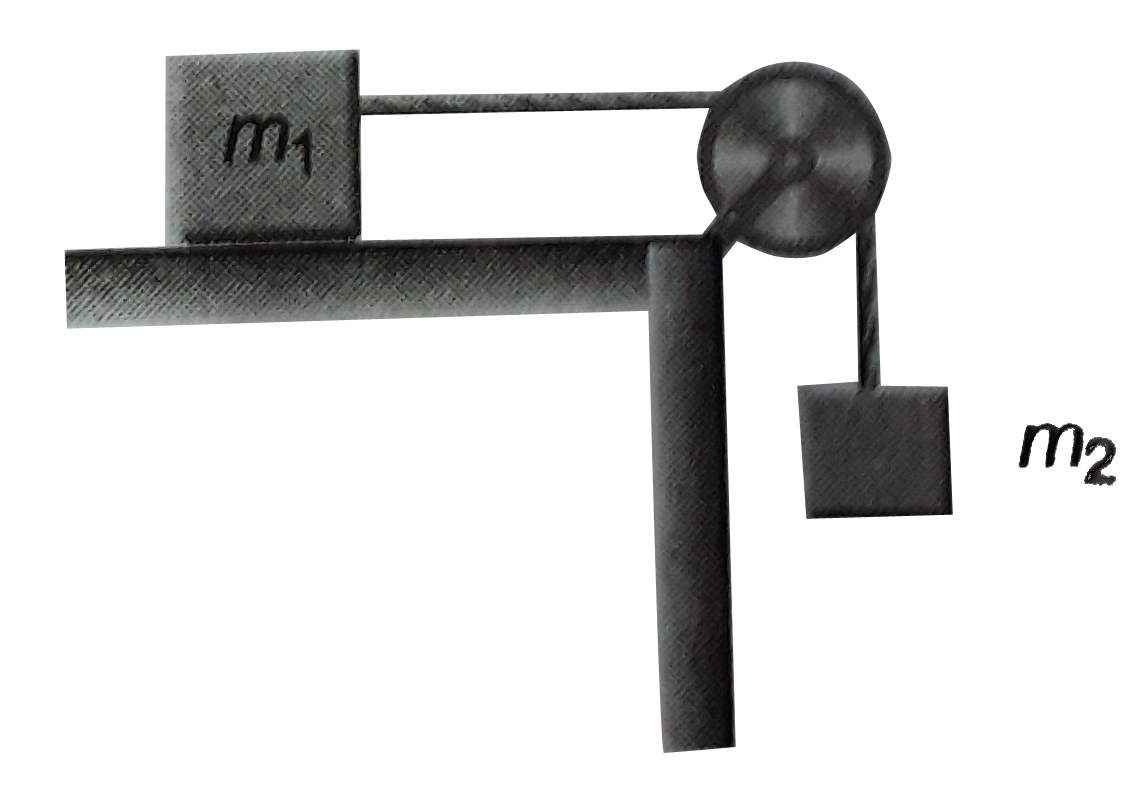
Two masses `m_(1) =10 Kg` and `m_(2)=5kg` are connected by an ideal string as shown in the figure. The coefficient of friction between `m_(1)` and the surface is `mu=0.2` Assuming that the system is released from rest calculate the velocity of blocks when `m_(2)` has descended by `4m`. `(g=10 m//s^(2))`
.

A

`2ms^(-1)`

B

`3ms^(-1)`

C

`4ms^(-1)`

D

`5ms^(-1)`

Text Solution

Verified by Experts

The correct Answer is:

C
Promotional Banner

Similar Questions

Explore conceptually related problems

Two block of masses m_(1) and m_(2) are connected as shown in the figure. The acceleration of the block m_(2) is:

Consider the system shown in the figure. Coefficient of friction between the block and table is mu=0.5. The system is released from rest. Find the work done by friction, when the speed of block is 10 m/s (m=1kg)

Two masses m_(1)=5kg and m_(2)=10kg, connected by an inextensible string over a frictionless pulley, are moving as shown in the figure. The coefficient of friction of horizontal surface is 0.15. The minimum weitght m that should be put on top of m_(2) to stop the motion is :-

Two moasses m_(1)=5kg and m_(2)=10kg, connected by an inextensible string over a frictionless pulley, are moving as shown in the figure. The coefficient of friction of horizontal surface is 0.15. The minimum weitght m that should be put on top of m_(2) to stop the motion is :-

Two blocks of masses m_(1)=1 kg and m_(2)=2 kg are connected by a string and side down a plane inclined at an angle theta=45^(@) with the horizontal. The coefficient of sliding friction between m_(1) and plane is mu_(1)=0.4, and that between m_(2) and plane is mu_(2)=0.2. Calculate the common acceleration of the two blocks and the tension in the string.

Two blocks of masses m_(1) = 10 kg and m_(2) = 20 kg are connected by a spring of stiffness k = 200 N/m. The coefficient of friction between the blocks and the fixed horizontal surface is mu = 0.1 . Find the minimum constant horizontal force F (in Newton) to be applied to m1 in order to slide the mass m_(2) . (Take g = 10 m//s^(2) )

Two block A and B of mass 50 kg and 300 kg respectively are placed as shown in figure. Coefficient of friction between all surface is (1)/(2) Then (take g = 10 m//s )

A block of mass m=2kg is resting on a rough inclined plane of inclination of 30^(@) as shown in figure. The coefficient of friction between the block and the plane is mu=0.5 . What minimum force F should be applied perpendicular to the plane on the block, so that blocks does not slip on the plane? (g=10m//s^(2))

Two block of masses m_(1) and m_(2) connected by a light spring rest on a horizontal plane. The coefficient of friction between the block and the surface is equal to mu . What minimum constant force has to be applied in the horizontal direction to the block of mass m_(1) in order to shift the other block?

The blocks ov mass m_(1)=1kg and m_(2)=2kg are connected by an ideal spring, rest on a rough horizontal surface. The spring is unstressed. The spring constant of spring is K=2N//m . The coefficient of friction between blocks and horizontal surface is mu=(1)/(2) . Now the left block is imparted a velocity u towards right as shown. The largest value of u( in m//s) such that the block of mass m_(2) never moves is ( Take g=10m//s^(2))
