Home
Class 11
PHYSICS
An underformed spring of spring constant...

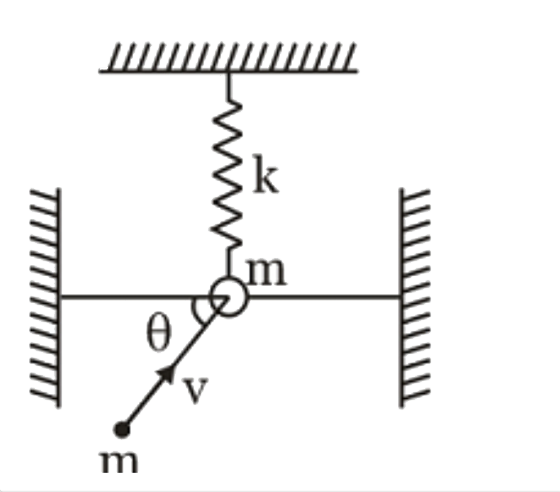
An underformed spring of spring constant k is connected to a bead of mass m which can move along a frictionless rod as shown in the figure. If the particle strikes the bead at an angle of `45^(@)` with the horizontal and sticks to it, then the maximum elongation of the spring after the collision is

A

`(sqrt(m/k))v`

B

`1/2(sqrt(m/k))v`

C

`2(sqrt(m/k))v`

D

`1/4(sqrt(m/k))v`

Text Solution

Verified by Experts

The correct Answer is:

B
Promotional Banner

Similar Questions

Explore conceptually related problems

Two identical springs of spring constant k are attached to a block of mass m and to fixed supports as shown in the figure. The time period of oscillation is

Two spring are connected toa block of mass M placed a frictionless surface as shown if both the spring have a spring constant k the frequency of oscillation block is

A block A of mass 2m is hanging from a vertical massless spring of spring constant k and is in equilibrium. Another block B of mass m strikes the block A with velocity u and sticks to it as shown in the figure. The magnitude of the acceleration of the combined system of the blocks just after the collision is

Four massless springs whose force constants are 2k, 2k, k and 2k respectively are attached to a mass M kept on a frictionless plane (as shown in figure). If the mass M is displaced in the horizontal direction.

A rod of mass 4m and length L is hinged at the mid point. A ball of mass 'm' moving with speed V in the plane of rod, strikes at the end at an angle of 45^@ and sticks to it. The angular velocity of system after collision is-

The block of mass M moving on the frictionless horizontal surface collides with the spring constant k and compresses it by length L . The maximum momention of the block after collision is

The block of mass m is released when the spring was in its natrual length. Spring constant is k. Find the maximum elongation of the spring.

A spring of spring constant k is cut into n equal parts, out of which r parts are placed in parallel and connected with mass M as shown in figure. The time period of oscillatory motion of mass M is:

Two blocks of masses m_(1)= 2 kg and m_(2) = 4 kg are moving in the same direction with speeds v_(1) = 6 m//s and v_(2) = 3 m//s , respectively on a frictionless surface as shown in the figure. An ideal spring with spring constant k = 30000 N//m is attached to the back side of m_(2) . Then the maximum compression of the spring after collision will be

A block of mass m is attached to one end of a mass less spring of spring constant k. the other end of spring is fixed to a wall the block can move on a horizontal rough surface. The coefficient of friction between the block and the surface is mu then the compession of the spring for which maximum extension of the spring becomes half of maximum compression is .
