Home
Class 11
PHYSICS
Two blocks of mass 4kg and 6kg are conne...

Two blocks of mass 4kg and 6kg are connected by a string as shown in the figure. They are initially at rest on the floor. Calculate their acceleration when a force of (a) 50N (b) 100N is applied on the pulley.

Text Solution

Verified by Experts
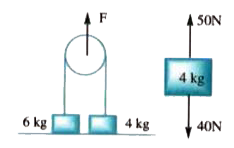
Case(i):
Force on 6kg and 4 kg object ` = (F)/(2)= 25N`.
The applied force on each block is less than the weight of each block. So the blocks will not move.
Case (ii):
A 50N Force on each block `=(100)/(2)` = 50N.
The 6kg block will not move because applied force is less than its weight.
On 4 kg mass
Resultant force = mass `xx` acceleration
`50-40 = 4a, 10 = 4a , a=2.5 m//s^(2)`
Promotional Banner

Similar Questions

Explore conceptually related problems

Two blocks of masses 3 kg and 6 kg are connected by a string as shown in the figure over a frictionless pulley. The acceleration of the system is A. 4m // s^2 B. 2m//s^2 C. zero D. 6m//s^2

Two bodies of 5 kg and 4 kg are tied to a string as shown in the figure. If the surface and pulley both are smooth, acceleration of 5 kg body will be equal to :

Two blocks of masses of 40 kg and 30 kg are connected by a weightless string passing over a frictionless pulley as shown in the figure.

Two blocks A and B of masses 2kg and 3kg are connected by a light string as shown in the figure and placed on a horizontal surface. mu between all surfaces is 0.1 and g = 10 ms^(-1) . The acceleration of the system is, when the force applied F = 45N

Two blocks of masses 6 kg and 4 kg are connected b a rope of mass 2 kg are resting on a frictionless floor as shown in the following figure: In a constant force of 60N is applied to 6 kg block then the tension in the rope at points A,B and C are respectively given by :

Two blocks of masses 5kg and 2 kg are initially at rest on the floor. They are connected by a light string. Passing over a light frictionless pulley. An upwards force F is applied on the pulley and maintained at a constant value. Calculate the acceleration a_(1) and a_(2) of the 5-kg and 2-kg masses, respectively, when F is (take g=10ms^(-2) ) (a) 30N, (b) 60N , (c) 140N .

Two blocks of masses 4kg and 2kg are placed side on a smooth horizontal surface as shown in the figure. A horizontal force of 20N is applied on 4kg block. Find (a) the acceleration of each block. (b) the normal reaction between two blocks.

Two blocks of masses 4kg and 2kg are placed side on a smooth horizontal surface as shown in the figure. A horizontal force of 20N is applied on 4kg block. Find (a) the acceleration of each block. (b) the normal reaction between two blocks.

Two block of mass 4 kg and 2 kg are attached by an inextensible light string as shown in figure. Both the blocks are pulled vertically upwards by a force F=120N Find (a) the acceleration of the blocks, (b) tension in the string. (Take g= 10 ms^(-2) )

Two block of mass 4 kg and 2 kg are attached by an inextensible light string as shown in figure. Both the blocks are pulled vertically upwards by a force F=120N Find (a) the acceleration of the blocks (b) tension in the string. (Take g= 10 ms^(-2) )

