Home
Class 11
PHYSICS
The pulley A and C are fixed while the p...

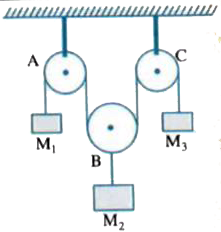
The pulley A and C are fixed while the pulley B is movable. A mass `M_2` is attached to pulley B , while the string has masses `M_1 and M_3` at the two ends. Find the acceleration of each mass .

Text Solution

Verified by Experts
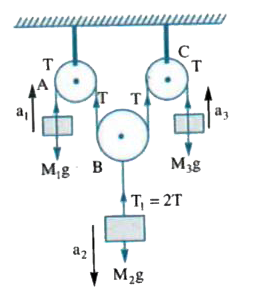
The force acting on masses ` M_1 , M_2 and M_3` are shown in figure .
Let ` a_2 and a_3` be upward acceleration of masses ` M_1 and M_3 and a_2` the downward acceleration of mass `M_2` .
For motion of mass `M_1 `
` T-M_1 g = M_1 a_1 `....... (1)
For motion of mass `M_3`
`T-M_3g = M_3 a_3` ........ (2)
For motion of mass `M_2`
`M_2g - 2T= M_2 a_2` ......... (3)
Let ` l_1 , l_2 , l_3` be the lengths of vertical portions of the string between pulley at any instant. `M_1` goes up through ` x , M_2` goes down through y and `M_3` goes up through z.
Then ` l_1 + 2l_2 + l_3 = ( l_1 - x) + 2 (l_2 + y) + l_3 -z`
`implies x + z = 2y implies (d^(2) x)/( dt^(2)) + (d^(2) z)/(dt^(2)) = 2(d^(2) y)/(dt^(2))`
` a_1 + a_3 = 2a_2 implies a_2 =(a_1 + a_3)/( 2) `.......... (4)
From (1) , ` a_1 =(T)/(M_1) - g ` ....... (5)

From (2) ` , a_3 = (T)/(M_3)-g` ............ (6)
substituting ` a_1 and a_3 ` is (4) , we get
` a_2 =(T)/(2) ((1)/(M_1) + (1)/(M_3))-g`......... (7)
From (3) , `T=(M_2(g-a_2))/(2)` .......... (8)
substituting this value in (7) , we get
`a_2 =(M_2)/(4) (g-a_2)((1)/(M_1 ) + (1)/(M_3))-g or a_2 = (M_2 (g-a_2) (M_3+M_1))/(4M_1M_3)-g`
` or 4M_1M_3 a_2 _ M_2(M_1 + M_3) g -M_2(M_1 + M_3) a_2- 4M_1 M_3 g `
`or [4M_1M_3 + M_2(M_1 + M_3)]a_2 = (M_1 + M_3) M_2 g - 4M_1 M_3 g `
` a_2 = ((M_1 + M_3) M_2 g - 4M_1 M_3g)/(4M_1 M_3 + M_2(M_1 + M_3))` `a_2=(M_1M_2 + M_2 M_3 - 4M_1 M_3)/(M_1 M_2 + M_2M_3 + 4M_1 M_3 )g`...... (9)
substituting value of T from (8) in (5)
` a_1 =(M_2(g-a_2))/(2M_1)-g`
Substituting value of `a_2` in above equation , we get
` a_1 =(-M_1 M-2 + 3M_2 M_3- 4M_1 M_3)/(M_1 M_2 + M_2M_3 + 4M_1 M_3)g` ........ (10)
Similarly from (6) and (9)
`a_3=(3M_1M_2 - M_2 M_3 - 4M_1 M_3)/( M_1 M_2 + M_2 M_3 -4M_1 M_3)` ........ (11)
Promotional Banner

Similar Questions

Explore conceptually related problems

Two block of masses m =5kg and M =10kg are connected by a string passing over a pulley B as shown. Another string connect the center of pulley B to the floor and passes over another pulley A as shown. An upwards force F is applied at the center of pulley A . Both the pulleys are massless. Find the acceleration of block m and M , if F is (a) 100N (b)300N (c)500N(Take g = 10m//s^(2))

If the string & all the pulleys are ideal, acceleration of mass m is :-

A block of mass m is tied to one end of a spring which passes over a smooth fixed pulley A and under a light smooth movable pulley B . The other end of the string is attached to the lower end of a spring of spring constant K_2 . Find the period of small oscillation of mass m about its equilibrium position (in second). (Take m=pi^2kg , K_2k=4K_1 , K_1=17(N)/(m). )

A smooth pulley A of mass M_(0) is lying on a frictionless table. A massless rope passes round the pulley and has masses M_(1) and M_(2) tied to its ends, the two portions of the string being perpendicular to the edge of the table so that the masses hang vertically. Find the acceleration of the pulley.

A block A of mass m is tied to a fixed point C on a horizontal table through a string passing round a massless smooth pulley B. A force F is applied by the experimenter to the pulley. Show that if the pulley is displaced by a distance x the block will be displaced by 2x. Find the acceleration of the block and the pulley.

In figure mass m_(1) slides without friction on the horizontal surface, the frictionless pulley is in the form of a cylinder of mass M and radius R , and a string turns the pulley without slipping. Find the acceleration of each mass, and tension in each part of the string.

In the figure shown neglecting friction and mass of pulley, what is the acceleration of mass B ?

A pulley fixed to the ceiling carried a thread with bodies of masses m_(1) and m_(2) attached to its ends. The mases of the pulley and the thread are negligible and friction is absent. Find the acceleration of the centre of mass of this system.

A block of mass m is attached at the end of an inextensible string which is wound over a rough pulley of mass M and radius R figure a. Assume the string does not slide over the pulley. Find the acceleration of the block when released.

A pulley fixed to the ceiling of an elevator car carries a thread whose ends are attached to the masses m_(1) and m_(2) . The car starts going up with an acceleration a_(0) . Assuming the masses of the pulley and the thread as well as the friction to be negligible, find: (a) the acceleration of the load m_(1) relative to the elevator shaft and relative to the car (b) the force exerted by the pulley on the ceiling of the car. Given m_(1) gt m_(2) .

