Home
Class 12
PHYSICS
A police car moving at 22(m)/(s) chases ...


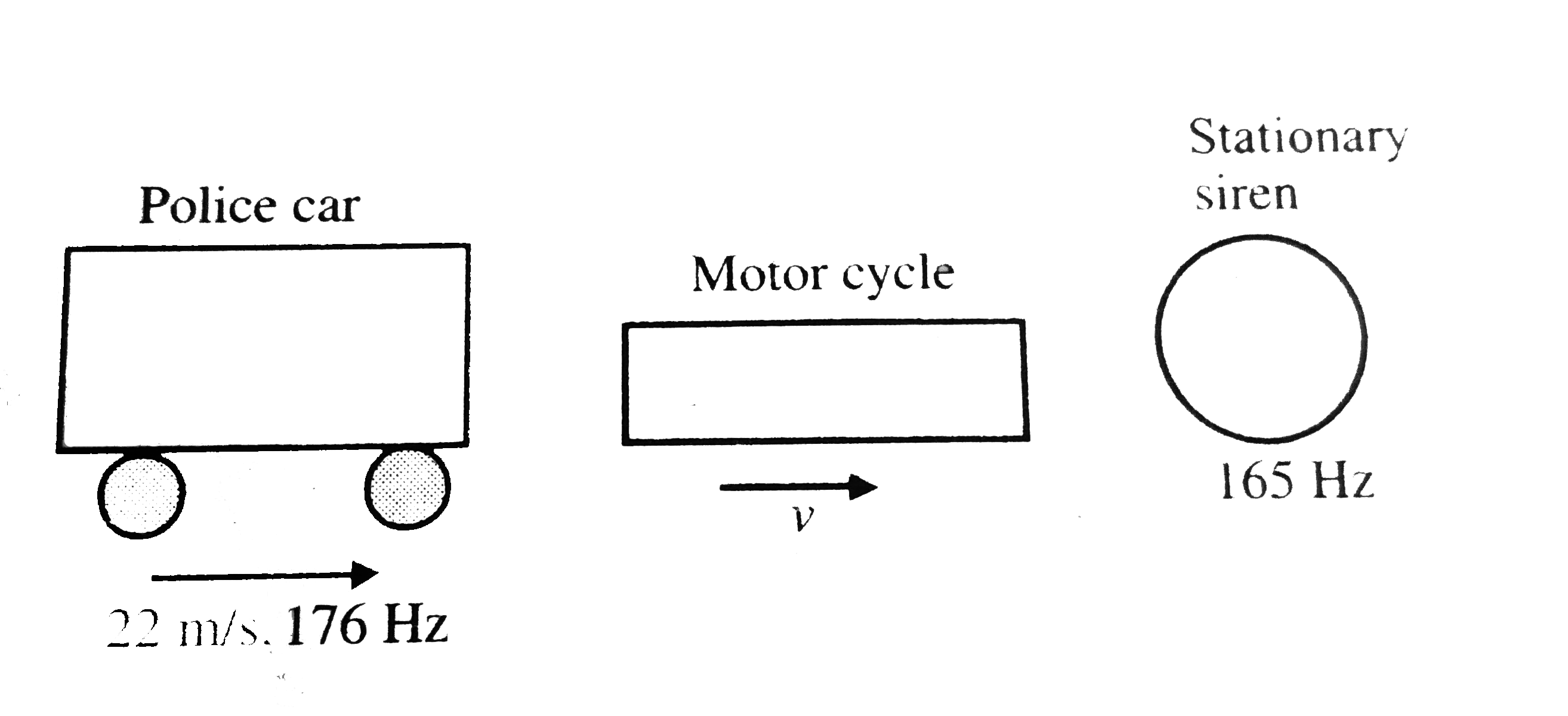
A police car moving at `22(m)/(s)` chases a motorcyclist. The police man sounds his horn of frequency 176 Hz, while both of them move towards a stationary siren of frequency 165 Hz. Calculate the speed of motorcyclist if it is given that he does not hear any beat (speed of sound in air is `330(m)/(s)`)

A

33 m/s

B

22 m/s

C

zero

D

11 m/s

Text Solution

Verified by Experts

The correct Answer is:

B
Promotional Banner

Topper's Solved these Questions

  • WAVES

    AAKASH SERIES|Exercise EXERCISE-III (Beats :)|6 Videos
  • WAVE OPTICS

    AAKASH SERIES|Exercise PROBLEMS (LEVEL - II)|33 Videos
  • WAVES OPTICS

    AAKASH SERIES|Exercise EXERCISE -III (POLARISITION)|10 Videos

Similar Questions

Explore conceptually related problems

A police car moving at 22m//s , chases a motorcyclist, the police man sounds his horn at 176 Hz , while both of them move towards a stationary siren of frequency 165 H z. Calculate the speed of the motorcycle, if it is given that he does not observes any beat

A police car moving at 22 m//s , chase a motoclist. The police man has horn at 176 H_(Z) , While both of them move towards a stationary siran of frequency 165 H_(Z) . Calulate the speed of the motorcyclist, if he does not observer any beats. (velocity of sound in air = 330 m//s)

A police car moving at 22 ms^(-1) chases a motor cyclist. The police man sounds horn at 176 Hz. While both of them move towards a stationary siren of frequency 165 Hz. If the number of beats heard by the motor cyclist per second is zero, then the speed of motorcycle is (Speed of sound in air = 330 ms^(-1) )

A police car moving at "30 m s"^(-1) , chases a motorcyclist. The policeman sounds his horn at 180 Hz, while both of them move towards a stationary siren of frequency 160 HZ. He does not observe any beats then, calculate the speed ("in m s"^(-1)) of the motorcyclist round off two decimal places? [speed of sound =330ms^(-1) ]

The frequency of the whistle of a train is observed to drop from 280 Hz to 260 Hz as the train moves away from a stationary listerner on the platform. Calculate the speed of the train, if speed of sound in air is 340 m/s.

An engine blowing a whistle of frequency 133 Hz moves with a velocity of 60(m)/(s) towards a hill from which an echo is heard. Calculate the frequency of the echo heard by the driver. (velocity of sound in air in 340(m)/(s) .)

An engine blowing a whistle of frequency 133 Hz moves with a velocity of 60(m)/(s) towards a wall from which an echo is heard. Calculate the frequency of the echo heard by the driver. (velocity of sound in air in 340(m)/(s) .)

A train moving at a speed of 220ms^-1 towards a stationary object emits a sound of frequency 1000 Hz. Some of the sound reaching the object gets reflected back to the train as echo. The frequency of the echo as detected by the driver of the train is (speed of sound in air is 330ms^(-1) )

A train moving at a speed of 220ms^-1 towards a stationary object emits a sound of frequency 1000 Hz. Some of the sound reaching the object gets reflected back to the train as echo. The frequency of the echo as detected by the driver of the train is (speed of sound in air is 330ms^(-1) )

a bus is moving towards and stationary observer with speed 20 m/s blows a horn of frequency 200 Hz. the frequency of sound heard by the observer is approximately ( take speed of sound 320 m/s)
