Home
Class 11
PHYSICS
Two billiard balls of same size and mass...

Two billiard balls of same size and mass are in contact on a billiard table. A third ball of same mass and size strikes them symmetrically and remains at rest after the impact. Find the coefficient of restitution between the balls?

Text Solution

Verified by Experts
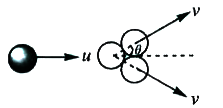

`sin theta = (r )/(2r)=(1)/(2), " " therefore theta = 30^(@)`
From conservation of linear momentum
`m u = 2mv cos 30^(@)` or `v=(u)/(sqrt(3))`
Now `e=("relative velocity of separation")/("relative velocity of approach")`
in common normal direction
Hence, `e=(v)/(u cos 30^(@))=(u//sqrt(3))/(u sqrt(3)//2)=(2)/(3)`
Promotional Banner

Similar Questions

Explore conceptually related problems

Two identical billiard balls are in contact on a table. A third identical ball strikes them symmetrically and comes to rest after impact. The coefficient of restitution is :

If the collision of a ball of mass m is inelastic, then the relation between theta and alpha is (where theta is the coefficient of restitution)

Two equal spheres B and C , each of mass m , are in contact on a smooth horizontal table. A third sphere A of same size as that of B or C but mass m//2 impinges symmetrically on them with a velocity u and is itself brought to rest. The coefficient of restitution between the two spheres A and B (or between A and C ) is

Ball 1 collides directly with another identical ball 2 at rest. Velocity of second ball becomes two times that of 1 after collison. Find the coefficient of restitution between the two balls?

Ball 1 collides directly with another identical ball 2 at rest. Velocity of second ball becomes two times that of 1 after collison. Find the coefficient of restitution between the two balls?

A ball of mass m moving at a speed v collides with another ball of mass 3m at rest. The lighter block comes to rest after collisoin. The coefficient of restitution is

A ball of mass m moving at a speed v makes a head-on collision with an identical ball at rest. The kinetic energy of the balls after the collision is three fourths of the original. Find the coefficient of restitution.

A ball is dropped on a smooth inclined plane and is observed to move horizontally after the impact. The coefficient of restitution between the plane and ball is e. The inclination of the plane is

A ball of negligible size and mass m is given a velocity v_0 on the centre of the cart which has a mass M and is originally at rest. If the coefficient of restitution between the ball and walls A and B is e. Determine the velocity of the ball and the cart just after the ball strikes A. Also, determine the total time needed for the ball to strike A, rebound, then strike B, and rebound and then return to the centre of the cart. Neglect friction.

A ball of mass m moving at a speed v makes a head on inelastic collision with an identical ball at rest. The kinetic energy of the balls after the collision is 3/4th of the original. Find the coefficient of restitution.

