Home
Class 11
PHYSICS
A ball A is falling vertically downwards...

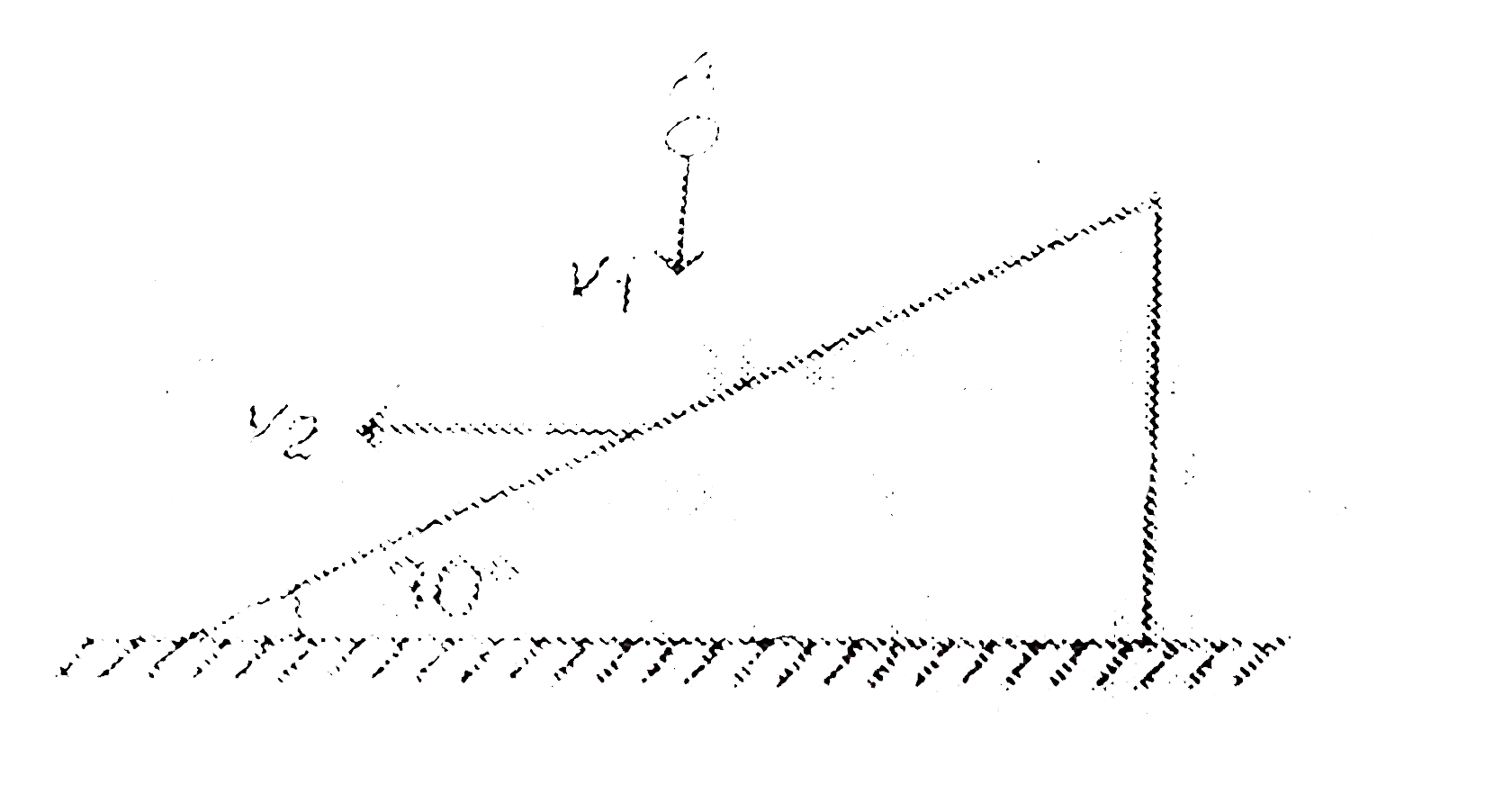
A ball A is falling vertically downwards with velocity `v_(1)` . It strikes elastically with a wedge moving horizontally with velocity `v_(2)` as shown in figure . What must be the ratio `(v_(1))/(v_(2))` , so that the ball bounces back in vertically upward direction relative to the wedge

Text Solution

Verified by Experts
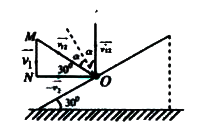
In the figure `vec(v_(12))` = velocity of ball w.r.t. wedge before collision and `vec(v)_(12)^(1)=` velocity of ball w.r.t. wedge after collision, which must be in vertically upward direction as shown.

In elastic collision, `vec(v_(12))` and `vec(v_(12)^(1))` will make equal angles (say `alpha`) with the normal to the plane. We can show that `alpha = 30^(@)`,
`therefore angle MON = 30^(@)` Now `(v_(1))/(v_(2))=tan 30^(@)=(1)/(sqrt(3))`
Promotional Banner

Similar Questions

Explore conceptually related problems

A shell is fired vertically upwards with a velocity v_(1) from a trolley moving horizontally with velocity v_(2) . A person on the the ground observes the motion of the shell as a parabole, whose horizontal range is

A small ball falling vertically downward with constant velocity 4m//s strikes elastically a massive inclined cart moving with velocity 4m//s horizontally as shown. The velocity of the rebound of the ball is

A ball of mass m moving with velocity v collides head on elastically with another identical ball moving with velocity - V. After collision

In the figure block moves downwards with velocity v_(1) , the wedge rightwards with velocity v_(2) . The correct relation between v_(1) and v_(2) is

A heavy ball of mass 2M moving with a velocity v_(0) collides elastically head on with a cradle of three identical ball each of mass M as shown in figure. Determine the velocity of each ball after collision.

A ball is projected horizontally from an inclined plane with a velocity V, as shown in the figure. It will strike the plane after a time

A particle of mass m_1 moving with velocity v in a positive direction collides elastically with a mass m_(2) moving in opposite direction also at velocity v. If m_(2)gt gtm_(1) , then

A ball of mass m moving vertically down , collides with inclined surface of the wedge . After the collision , wedge starts moving in horizontal direction with velocity v_(0) . If all the surfaces are smooth then impulse applied by wedge on the ball during collision is given by

A ball is thrown vertically upwards from the top of tower of height h with velocity v . The ball strikes the ground after time.

In fig., blocks A and B move with velocities v_(1) and v_(2) along horizontal direction. Find the ratio of v_(1)//v_(2)

