Home
Class 11
PHYSICS
The bob A of a pendulum released from 30...

The bob A of a pendulum released from `30^(@)` to the vertical hits another bob B of the same mass at rest on a table as shown in fig. How high does the bob A rise after the collision? Neglect the size ofthe bobs and assume the collision to be elastic.

Text Solution

Verified by Experts
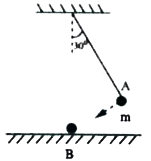
The bob of pendulum acquires a velocity
`V=sqrt(2gl(1-cos theta))`,
on reaching the lower most position and makes elastic collision with the bob B of same mass.

Hence the bodies simply exchange their velocities after collision. The bob of pendulum does not rise at all and velocity of B is
`V = sqrt(2gl(1-cos theta))=1.62 ms^(-1)`
Promotional Banner

Similar Questions

Explore conceptually related problems

The bob A of a simple pendulum released from 30^(@) to the vertical hits another bobo B of the same mass at rest on a table as shown in figure. How high does the bob A rise after the collision ? Neglect the size of the bobs and assume the collision to be elastic.

The bob A of a pendulum released from horizontal to the vertical hits another bob B of the same mass at rest on a table as shown in figure. If the length of the pendulum is 1m, calculate (a) the height to which bob A will rise after collision. (b) the speed with which bob B starts moving. Neglect the size of the bobs and assume the collision to be elastic.

The bob A of a pendulum released from horizontal to the vertical hits another bob B of the same mass at rest on a table as shown in figure. If the length of the pendulum is 1m, calculate (a) the height to which bob A will rise after collision. (b) the speed with which bob B starts moving. Neglect the size of the bobs and assume the collision to be elastic.

The bob A of a simple pendulum is released when the string makes an angle of 45^(@) with the vertical. It hits another bob B of the same material and same mass kept at rest on the table. If the collision is elastic, then

Two identical ball bearings in contact with each other and resting on a frictionless table are hit heat-on by another ball bearing of the same mass moving initially with a speed V as shown in figure. If the collision is elastic, which of the following (figure) is a possible result after collision ?

Two identical ball bearings in contact with each other and resting on a frictionless table are hit heat-on by another ball bearing of the same mass moving initially with a speed V as shown in figure. If the collision is elastic, which of the following (figure) is a possible result after collision ?

Two identical ball bearings in contact with each other and resting on a frictionless table are hit heat-on by another ball bearing of the same mass moving initially with a speed V as shown in figure. If the collision is elastic, which of the following (figure) is a possible result after collision ?

The bob of a simple pendulum is displaced from its equilibrium position 'O' to a position 'Q' which is at a height 'h' above 'O' and the bob is then released. Assuming the mass of the bob to be 'm' and time period of oscillation to be 2.0s , the tension in the string when the bob passes through 'O' is

The bob of a simple pendulum is displaced from its equilibrium position 'O' to a position 'Q' which is at a height 'h' above 'O' and the bob is then released. Assuming the mass of the bob to be 'm' and time period of oscillation to be 2.0s , the tension in the string when the bob passes through 'O' is

Two pendulum bobs of masses m and 2m collide head on elastically at the lowest point in their motion. If both the balls are released from a height H above the lowest point, to what heights do they rise for the first time after collision?

