Home
Class 11
PHYSICS
A raindrop falling from a height h above...

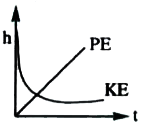
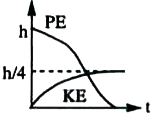
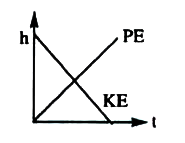
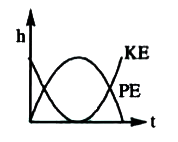
A raindrop falling from a height h above ground, pure ring attains a near terminal velocity when it has fallen through a height`(3/4)h`. Which of the diagrams shown in figure correctly shows the change in kinetic and potential energy of the drop during its fall up to the ground ?

A

B

C

D

Text Solution

Verified by Experts

The correct Answer is:

B
Promotional Banner

Similar Questions

Explore conceptually related problems

A raindrop falling from a height h above ground, attains a near terminal velocity when it has fallen through a height (3//4)h . Which of the diagrams shown in figure correctly shows the change in kinetic and potential energy of the drop during its fall up to the ground ?

Which of the diagrams in figure, correctly shows the change in kinetic energy of an iron sphere falling freely in a lake having sufficient depth to impart if a terminal velocity ?

A ball is dropped from a height h above ground. Neglect the air resistance, its velocity (v) varies with its height (y) above the ground as :-

Which of the following graph is correct between kinetic energy E , potential energy (U) and height (h) from the ground of the partical

A body freely falling from the rest has velocity v after it falls through a height h the distance it has to fall down for its velocity to become double is

A ball of mass 2kg dropped from a height H above a horizontal surface rebounds to a height h after one bounce. The graph that relates H to h is shown in figure. If the ball was dropped from an initial height of 81 m and made ten bounces, the kinetic energy of the ball immediately after the second impact with the surface was

A nonconducting disk of radius a and uniform positive surface charge density sigma is placed on the ground, with its axis vertical. A particle of mass m and positive charge q is dropped, along the axis of the disk, from a height H with zero initial velocity. The particle has q//m = 4 epsilon_(0) g// sigma . (i) Find the value of H if the particle just reaches the disk. (ii) Sketch the potential energy of the particle as a function of its height and find its equilibrium position.

A stone projected vertically upwards from the ground reaches a maximum height h . When it is at a height (3h)//(4) , the ratio of its kinetic and potential energies is

Total energy of a body at rest at a height h from a point of reference is 75 J. What is its kinetic energy as it falls through a height h/2 ?
