Home
Class 11
PHYSICS
Which of the diagrams in figure correctl...

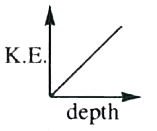
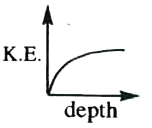
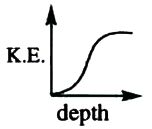
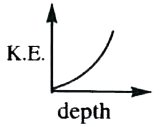
Which of the diagrams in figure correctly shows the change in kinetic energy of an iron sphere falling freely in a lake having sufficient depth to impartita terminal velocity?

A

B

C

D

Text Solution

Verified by Experts

The correct Answer is:

B
Promotional Banner

Similar Questions

Explore conceptually related problems

Which of the diagrams in figure, correctly shows the change in kinetic energy of an iron sphere falling freely in a lake having sufficient depth to impart if a terminal velocity ?

Which of the diagrams shown in figure. Most closely shows the variation inkinetic energy of the earth as it moves once around the sun in its elliptical orbit ?

A raindrop falling from a height h above ground, attains a near terminal velocity when it has fallen through a height (3//4)h . Which of the diagrams shown in figure correctly shows the change in kinetic and potential energy of the drop during its fall up to the ground ?

Calculate the kinetic energy of a hollow metal sphere of mass 2 kg, which rolls over a horizontal surface with a linear velocity of 20 cm/s ?

Which of the following graph correctly represents velocity-time relationship for a particle released from rest to fall freely under gravity ?

A flywheel can rotate in order to store kinetic energy. The flywheel is a uniform disc made of a material with a density rho and tensile strength sigma (measured in Pascals), a radiys r , and a thickness h . The flywheel is rotating at the maximum possible angular velocity so that it does not break. Which of the following expression correctly gives the maximum kinetic energy kilogram that can be stored in the flywheel? Assume that alpha is a dimensionless constant.

A particle starts moving from the origin & moves along positive x-direction. Its rate of change of kinetic energy with time shown on y-axis varies with time t as shown in the graph. If position, velocity acceleration & kinetic energy of the particle at any time t are x,v a & k respectively then which of the option (s) may be correct ?

A particle starts moving from rest the origin & moves along positive x- direction . Its rate of change of kinetic energy with time shown on y- axis veries with time t as shown in the graph. If position, velocity , acceleration & kinetic energy of the particle at any time t are x,v,a,& k respectively then which of the option (s) may be correct ?

In a photoelectric effect experiment , the maximum kinetic energy of the ejected photoelectrons is measured for various wavelength of the incident light. Figure shows a graph of this maximum kinetic energy K_(max) as a function of the wavelength lamda of the light falling on the surface of the metal. Which of the following statement/i is/ are correct?

Newton's laws of motion are applicable in all inertial reference frames. Some physical quantities, when measured by observers in different reference frames, have exactly the same value. Such physical quantities are called invariant. In Newtonian mechanics mass, time and force are invariant quantities . On the other hand, some physical quantities, when measured by observer in different reference frames, do not have the same value. Sigmae physical quantities are called not invariant . In Newtonian mechanics displacement, velocity and work ( which is the dot product of force and displacement) are not invariant. Also kinetic energy (=1/2mv^(2)) is not invariant. Physicists believe that all laws of physics are invariant in all inertial frames, i.e. the work-energy principle states that the change in the kinetic energy of a particle is equal to the work done on it by the force. Although, work and kinetic energy are not invariant in all reference frames, the work-energy principle remains invariant. Thus even though different observers measuring the motion of the same particle find different values of work and change in kinetic energy, they all find the work energy principle holds in their respective frames. Which of the following quantities is invariant?
