Home
Class 11
PHYSICS
If the particle of mass m is moving with...

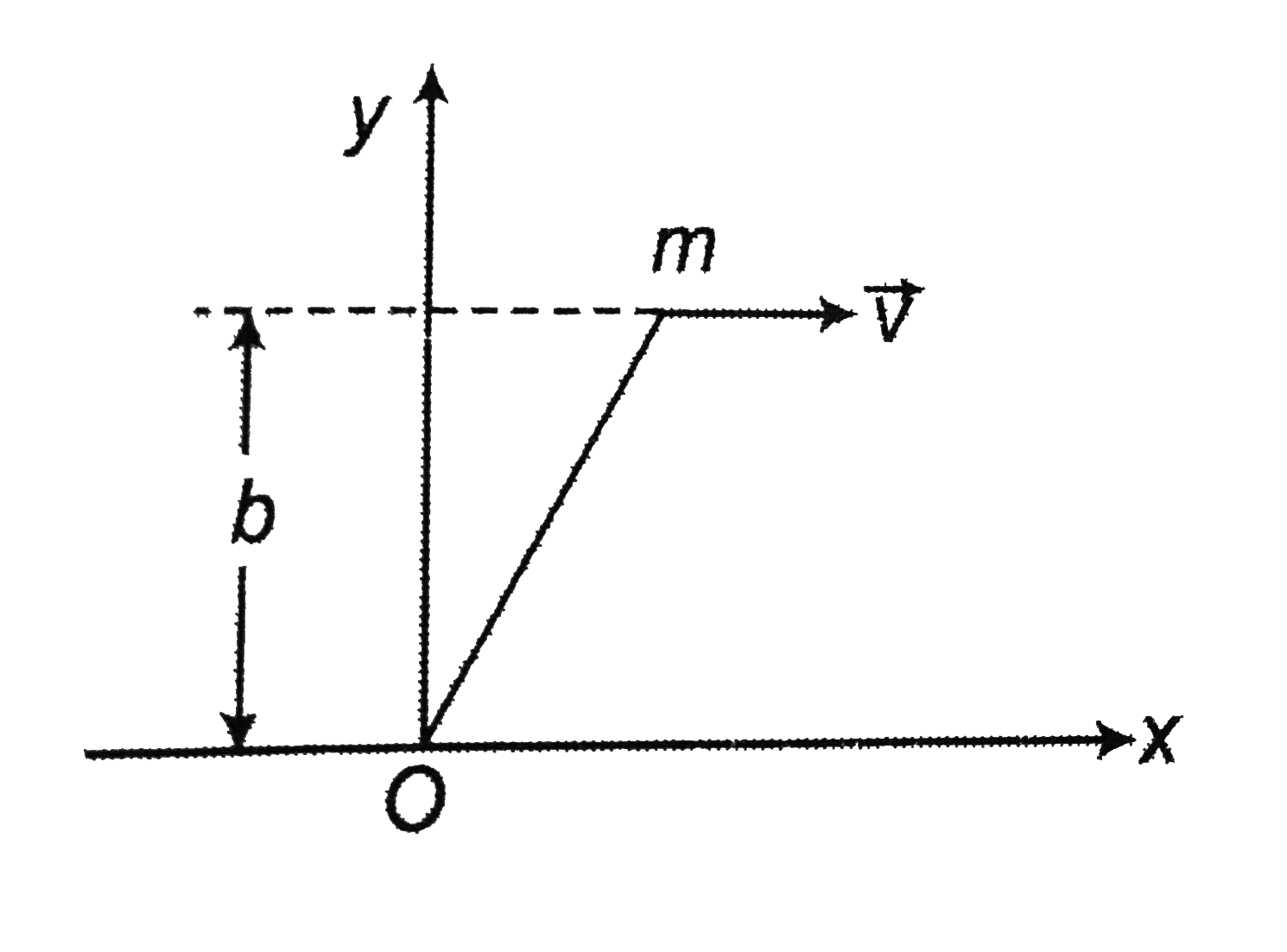
If the particle of mass `m` is moving with constant velocity `v` parallel to x-axis in x-y plane as shown in (figure), Find its angular momentum with respect to origin at any time `t`.

A

zero

B

mvh and is directed along positive z-axis

C

mvh and is directed along negative z-axis

D

mvh and is directed along positive x-axis

Text Solution

Verified by Experts

The correct Answer is:

C
Promotional Banner

Similar Questions

Explore conceptually related problems

If the particle of mass m is moving with constant velocity v parallel to x-axis in x-y plane as shown in (figure), Find its angular momentum with respect of origin at any time t .

A particle of mass m is moving with constant velocity v parallel to the x-axis as shown in the figure. Its angular momentum about origin O is

A mass m is moving with a constant velocity along a line parallel to the x-axis, away from the origin. Its angular momentum with respect to the origin.

A particle of mass m moves in the XY plane with constant velocity v along the straight line PQ as shown in the figure. Its angular momentum with respect to origin O is( theta is angle between vec v and x-axis)

A body of mass m is moving with a constant velocity along a line parallel to the x-axis, away from the origin. Calculate its angular momentum with respect to the origin?

A particle is moving in x-y plane as shown in the figure. Angular velocity of the particle with respect to the origin is

A particle is moving with constant speed v in xy plane as shown in figure. The magnitude of its angular velocity about point O is

A mass M moving with a constant velocity parallel to the X-axis. Its angular momentum with respect to the origin

A particle of mass m is moving with constant speed v on the line y=b in positive x-direction. Find its angular momentum about origin, when position coordinates of the particle are (a, b).

A particle of mass m moves in the XY plane with a velocity v along the straight line AB . If the angular momentum of the particle with respect to origin O is L_(A) when it is at A and L_(B) when it is at B, then
