Home
Class 11
PHYSICS
A particle is moving along a straight li...

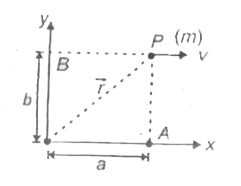
A particle is moving along a straight line parallel to x-axis with constant velocity. Find angular momentum about the origin in vector form

A

remains constant

B

increases

C

decreases

D

may increase or decrease

Text Solution

Verified by Experts

The correct Answer is:

A
Promotional Banner

Similar Questions

Explore conceptually related problems

A particle is moving along a straight line with increasing speed. Its angular momentum about a fixed point on this line :

If a particle is moving along straight line with increasing speed, then

A particle of mass m is moving with constant velocity v parallel to the x-axis as shown in the figure. Its angular momentum about origin O is

A particle mass parallel to x-axis with constant velocity v as shown in the figure. The angular velocity of the particle about the origin O

A particle moves on a straight line with a uniform velocity. It's angular momentum

On a frictionless horizontal surface , assumed to be the x-y plane , a small trolley A is moving along a straight line parallel to the y- axis ( see figure) with a constant velocity of (sqrt(3)-1) m//s . At a particular instant , when the line OA makes an angle of 45(@) with the x - axis , a ball is thrown along the surface from the origin O . Its velocity makes an angle phi with the x - axis and it hits the trolley . (a) The motion of the ball is observed from the frame of the trolley . Calculate the angle theta made by the velocity vector of the ball with the x- axis in this frame . (b) Find the speed of the ball with respect to the surface , if phi = (4 theta )//(3) .

On a frictionless horizontal surface , assumed to be the x-y plane , a small trolley A is moving along a straight line parallel to the y -axis( see figure) with a constant velocity of (sqrt(3)-1) m//s . At a particular instant , when the line OA makes an angle of 45(@) with the x - axis , a ball is thrown along the surface from the origin O . Its velocity makes an angle phi with the x -axis and it hits the trolley . (a) The motion of the ball is observed from the frame of the trolley . Calculate the angle theta made by the velocity vector of the ball with the x -axis in this frame . (b) Find the speed of the ball with respect to the surface , if phi = (4 theta )//(3) .

A particle is moving parallel to x-axis as shown in the figure. The angular velocity of the particle about the origin is

A mass M moving with a constant velocity parallel to the X-axis. Its angular momentum with respect to the origin

A particle of mass m=3kg moves along a straight line 4y-3x=2 where x and y are in metre, with constant velocity v=5ms^(-1) the magnitude of angular momentum about the origin is
