Home
Class 11
PHYSICS
Consider a system consisting of two iden...

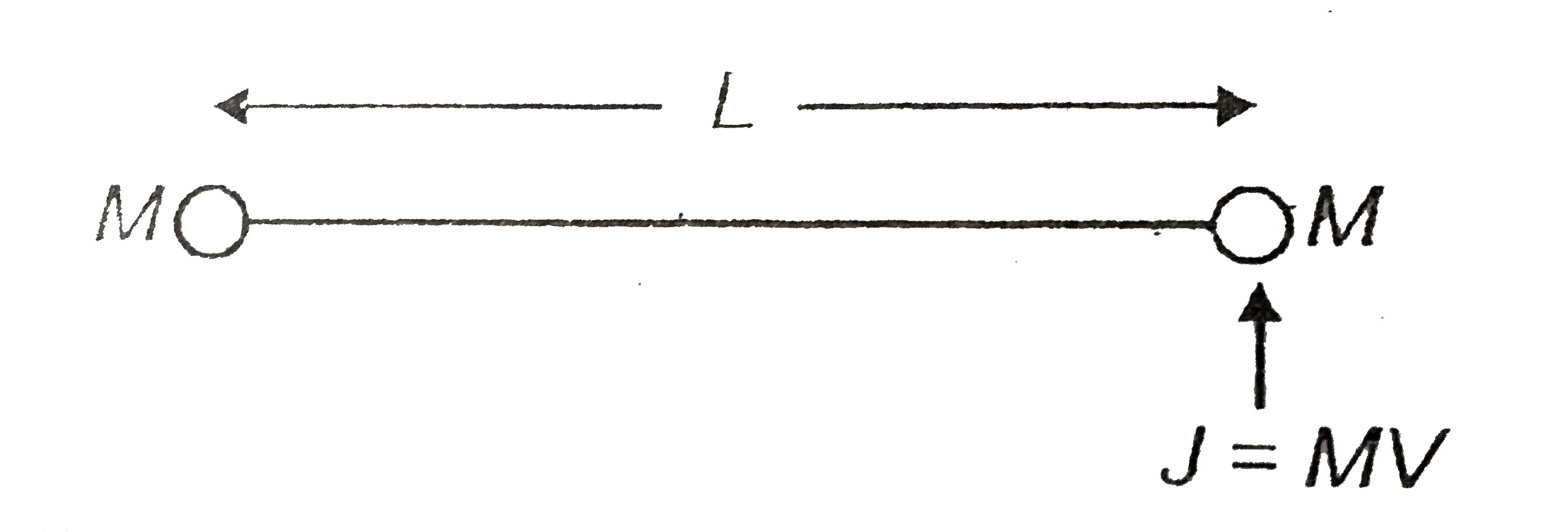
Consider a system consisting of two identical balls each of mass `M` connected by a light rigid rod as shown in figure. An impulse `J=MV` is imparted to the system at one of its ends. The angular velocity of the system would be

A

V/L

B

2V/L

C

V/3L

D

V/4L

Text Solution

Verified by Experts

The correct Answer is:

A
Promotional Banner

Similar Questions

Explore conceptually related problems

Consider a body, shown in figure, consisting of two identical balls, each of mass M connected by a light rigid rod. If an impulse J = MV is imparted to the body at one of its ends what would be it angular velocity?

Consider a body, shown in figure, consisting of two identical balls, each of mass M connected by a light rigid rod. If an impulse J = MV is imparted to the body at one of its ends what would be it angular velocity?

Two identical rods each of mass m and length are connected as shown. Locate c.m.

Two particles each of mass M are connected by a massless rod. The rod is lying on the smooth horizontal surface. If one of the particle is given an impulse MV as shown in the figure then angular velocity of the system would be:

Fig. shows a ball having a charge q fixed at a point A. Two identical balls of mass m having charge +q and -q are attaached to the end of a light rod of length 2a. The system is released from the situation shown in fig. Find the angular velocity of the rod when the rod turns through 90^(@)

Two particles connected by a rigid light rod AB, lying on a smooth horizontal table. An impulse J is applied at A in the plane of thetable and perpendicular at AB. Then the velocity of particle at A is

Consider a light rod with two heavy mass particles at its ends. Let AB be a line perpendicular to the rod as shown in figure. What is the moment of inertia of the system about AB?

A rigid uniform rod of mass M and length L is placed along the Y-axis on a smooth horizontal surface with its centre at the origin. Two particles , each of mas m ( = M //12) hits simultaneously , at the two ends with equal speed v as shown in the figure. The collision is completely inelastic. (i) Find the angular velocity of the system after the collision. (ii) Two particles of mass 2m and m are placed respectively at ( L//2, 0) and ( - L//2, 0) . Calculate the time when the rod hits these particles.

A system consists of t wo identical masses A and B of mass m each connected to ends of a massless spring of force constant k as shown in figure. The minimum force F applied vertically downward on A, such that on its release, B will leave the floor.

Two point masses m and 4m are connected by a light rigid rod of length l at the opposite ends. Moment of inertia of the system about an axis perpendicular to the length and passing through the centre of mass is
