Home
Class 11
PHYSICS
Consider a cylinder of mass M resting on...

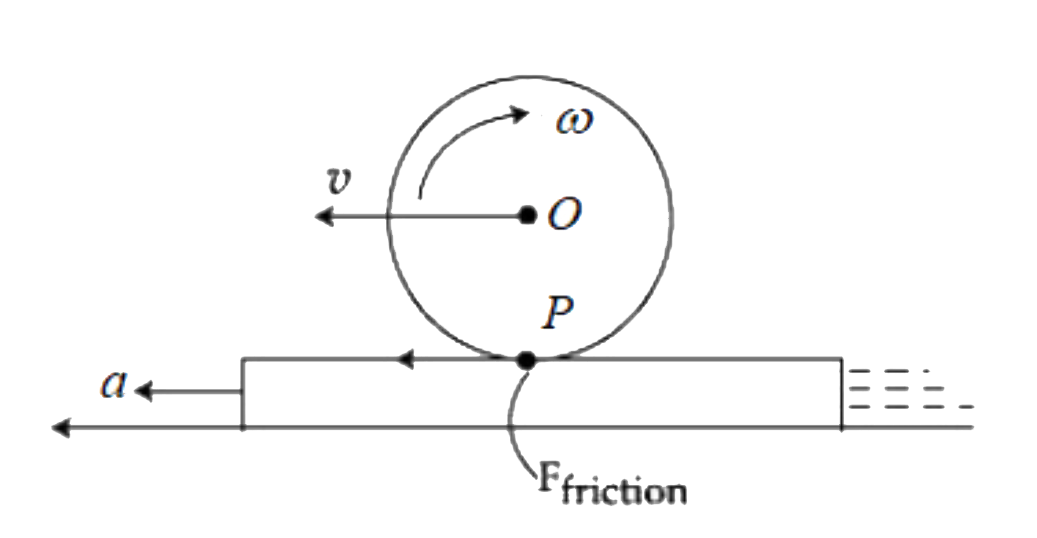
Consider a cylinder of mass M resting on a rough horizontal rug that is pulled out from under it with acceleration 'a' perpendicular to the axis of the cylinder. What is `F_("friction")` at point P ? It is assumed that the cylinder does not slip.

A

`(Ma)/(3)`

B

Mg

C

`(Ma)/(2)`

D

Ma

Text Solution

Verified by Experts

The correct Answer is:

A
Promotional Banner

Similar Questions

Explore conceptually related problems

The moment of inertia of a solid cylinder of mass M, length 2R and radius R about an axis passing through the centre of mass and perpendicular to the axis of the cylinder is I_(1) and about an axis passing through one end of the cylinder and perpendicular to the axis of cylinder is I_(2)

A wooden block of mass M resting on a rough horizontal surface is pulled with a force T at an angle q to the horizontal. If m is coefficient of kinetic friction between the block and the surface, the acceleration of the block is

A uniform solid cylinder of mass m and radius R is placed on a rough horizontal surface. A horizontal constant force F is applied at the top point P of the cylinder so that it start pure rolling. The acceleration of the cylinder is

A bullet of mass m moving with a velocity of u just grazes the top of a solid cylinder of mass M and radius R resting on a rough horizontal surface as shown and is embedded in the cylinder after impact. Assuming that the cylinder rolls without slipping, find the angular velocity of the cylinder and the final velocity of the bullet.

Consider a cylinder of mass M and radius R lying on a rough horizontal plane. It has a plank lying on its top as shown in the figure. A force F is applied on the plank such that the plank moves and causes the cylinder to roll. The plank always remains horizontal. There is no slipping at any point to contact. (a) what are the directions of the fricition forces acting at A and B on the plank and the cylinder ? (b) Calculate the acceleration of the cylinder. (c ) Find the value of frictional force at A & B .

Consider a cylinder of mass M and radius R lying on a rough horizontal plane. It has a plank lying on its top as shown in figure. A force F is applied on the plank such that the plank moves and causes the cylinder to roll the plank always remains horizontal. there is no slipping at any point of contact. Calculate the acceleration of the cylinder and the frictional forces at the two contact.

Find the moment of inertia of a uniform cylinder about an axis through its centre of mass and perpendicular to its base. Mass of the cylinder is M and radius is R.

A load of mass m is attached to the end of a string wound on a cylinder of mass M and radius R . The string passes round a pulley. a. Find the acceleration of the cylinder M when it rolls. b. If the coefficient of friction is mu . Find the accelerative of the cylinder when it slips and rolls. c. Find the minimum value of coefficient of friction for which the cylinder rolls always

Moment of inertia of a cylinder of mass M, length L and radius R about an axis passing through its centre and perpendicular to the axis of the cylinder is I = M ((R^2)/4 + (L^2)/12) . If such a cylinder is to be made for a given mass of a material, the ratio L//R for it to have minimum possible I is :

Uniform solid cylinder of mass m and radius R is placed on a rough horizontal surface. A horizontal constant force is applied at the top point P of the cylinder so that it start pure rolling .In the above question, the frictional force on the cylinder is
