Home
Class 11
PHYSICS
According to Newton.s second law of moti...

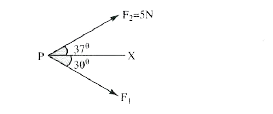
According to Newton.s second law of motion, resultant force on a particle is in the direction of acceleration of the particle. Two forcce `F_(1) and F_(2)` are acting on a particle as shown in the figure. The acceleration of the particle is along X-axis. FInd the value of `F_(1)` (in newton)

Text Solution

Verified by Experts

The correct Answer is:

6
Promotional Banner

Similar Questions

Explore conceptually related problems

The acceleration of a particle starting from rest and travelling along a straight line is shown in figure. The maximum speed of the particle is

A graph between the square of the velocity of a particle and the distance s moved by the particle is shown in the figure. The acceleration of the particle is

When a force F acts on a particle of mass m, the acceleration of particle becomes a. now if two forces of magnitude 3F and 4F acts on the particle simultaneously as shown in figure, then the acceleration of the particle is

The variation of force (F) acting on a particle of mass 800 g with position (x) is as shown in figure. The time period of oscillation of the particles is

Two forces act on a particle simultaneously as shown in the figure. Find net force in milli newton on the particle. [Dyne is the CGS unit of forces ]

A particle moves under force F =5(x -2)^(3) .Motion of the particle is

Displacement x versus t^(2) graph is shown for a particle. The acceleration of particle is

Two forces f_(1)=4N and f_(2)=3N are acting on a particle along positve X- axis and negative y- axis respectively. The resultant force on the particle will be -

When a force F acts on a body of mass m the acceleration product in the body is a . If three equal forces F_(1)=F_(2)=F_(3)=F act on the same body as shown in figure the acceleration produced is

A force F acts on a particle kept on a rough surface as shown in the figure. The particle is at rest. Find the net force applied by ground on the particle.
