Home
Class 11
PHYSICS
The minimum horizontal acceleration of t...

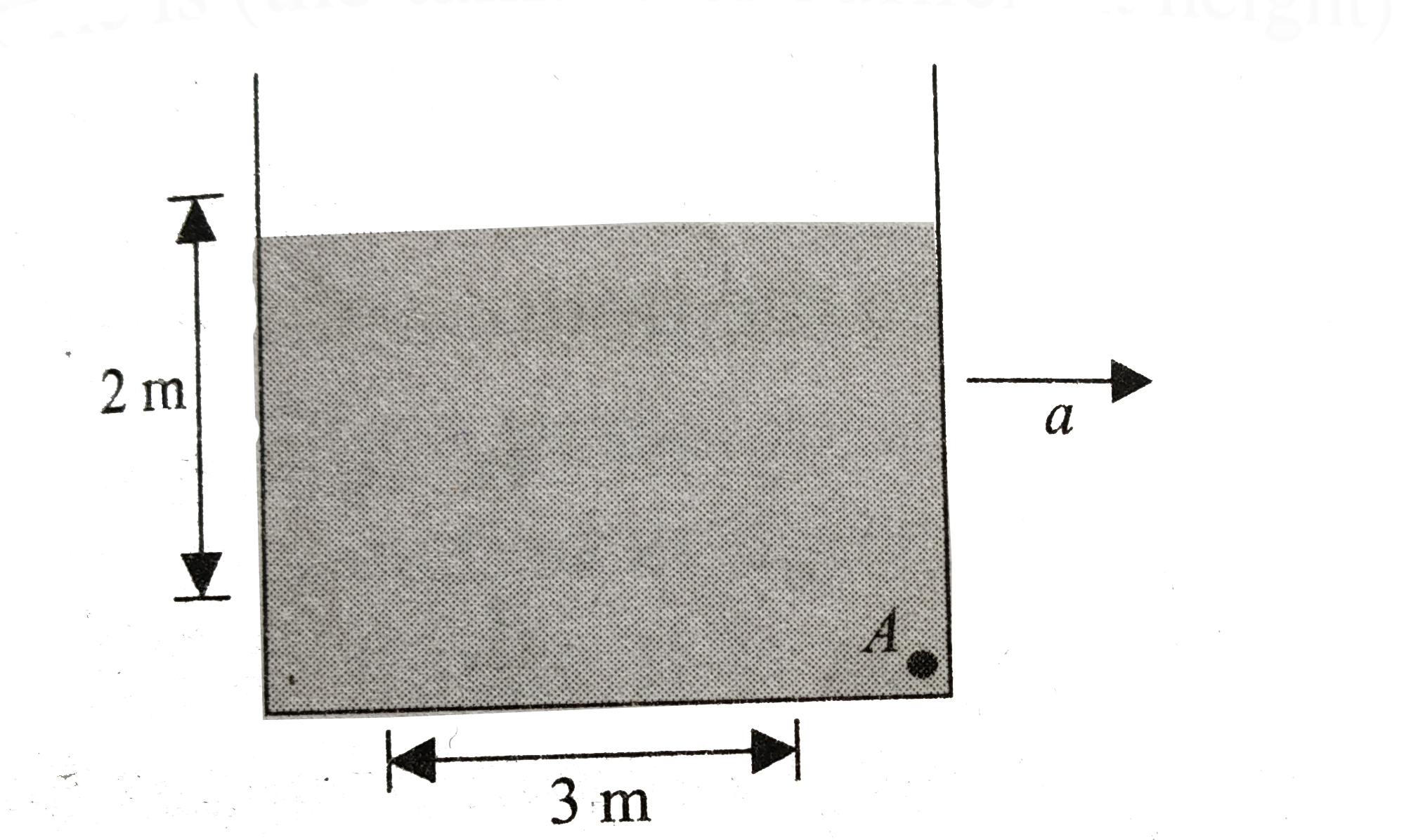
The minimum horizontal acceleration of the container so that the pressure at point `A` of the container becomes atmospheric is (the tank is of sufficient height)

A

`(3)/(2)g`

B

`(4)/(3)g`

C

`(4)/(2)g`

D

`(3)/(4)g`

Text Solution

Verified by Experts

The correct Answer is:

B
Promotional Banner

Similar Questions

Explore conceptually related problems

The minimum horizontal acceleration of the container a so that pressure at the point A of the container becomes atmospheric is (The tank is of sufficient height)

The minimum horizontal acceleration of the container4 so that pressure at the point A of the container becomes atmospheric is (The tank is of sufficient height)

The pressure at the bottom of a liquid container is determined by the

Figure shows an L -shaped tube tilled with a liquid to a height H . What should be the horizontal acceleration a of the tube so that the pressure at the point A becomes atmospheric.

A rectangular container moves with an acceleration a along the positive direction as shown in figure. The pressure at the A in excess of the atmospheric pressure p_(0) is (take rho as the density of liquid)

For the L -shaped vessel shown in the figure, determine the value of acceleration a so that pressure at point A becomes equal to p_(0)/2 ? ( p_(0) is the atmospheric pressure)

Two very large open tanks A & F both contain the same liquid. A horizontal pipe BCD , having a small constriction at C , leads out of the bottom of tank A , and a vertical pipe E containing air opens into the constriction at C and dips into the liquid in tank F . Assume stremline flow and no viscosity. If the cross section area at C is one-half that at D , and if D is at distance h_(1) below the level of the liquid in A , to what height h_(2) will liquid rise in pipe E ? Express your answer in terms of h_(1) . [Neglect changes in atmosphere pressure with elevation. In the containers there is atmosphere above the water surface and D is also open to atmosphere.]

Two containers A and B of equal volume V_(0)//2 each are connected by a narrow tube which can be closed by a value. The containers are fitted with pistons which can be moved to change the volumes. Initially the value is open and the containers contain an ideal gas (C_(p)//C_(v)=gamma) at atmospheric pressure P_(0) and atmospheric temperature 2T_(0) . The walls of the containers A are highly conducting and of B are non-conducting. The value is now closed and the pistons are slowly pulled out to increase the volumes of the containers to double the original value. (a) Calculate the temperature and pressure in the two containers. (b) The value is now opened for sufficient time so that the gases acquire a common temperature and pressure. Find the new values of the temperature and the pressure.

If the container filled with liquid gets accelerated horizontally or vertically, pressure in liquid gets changed. In liquid ( a_(y) ) for calculation of pressure, effective g is used. A closed box horizontal base 6 m by 6 m and a height 2m is half filled with liquid. It is given a constant horizontal acceleration g//2 and vertical downward acceleration g//2 . Water pressure at the bottomof centre of the box is equal to (atmospheric pressure =10^(5)N//m^(2) density of water =1000 kg//m^(3),g=10m//s^(2) )

An ideal gas is pumped into a rigid container having diathermic walls so that the temperature remains constant. In a certain time interval, the pressure in the container is doubled. Is the internal energy of the contains of the container also doubled in the interval?
