Home
Class 11
PHYSICS
When air of density 1.3kg//m^(3) flows a...

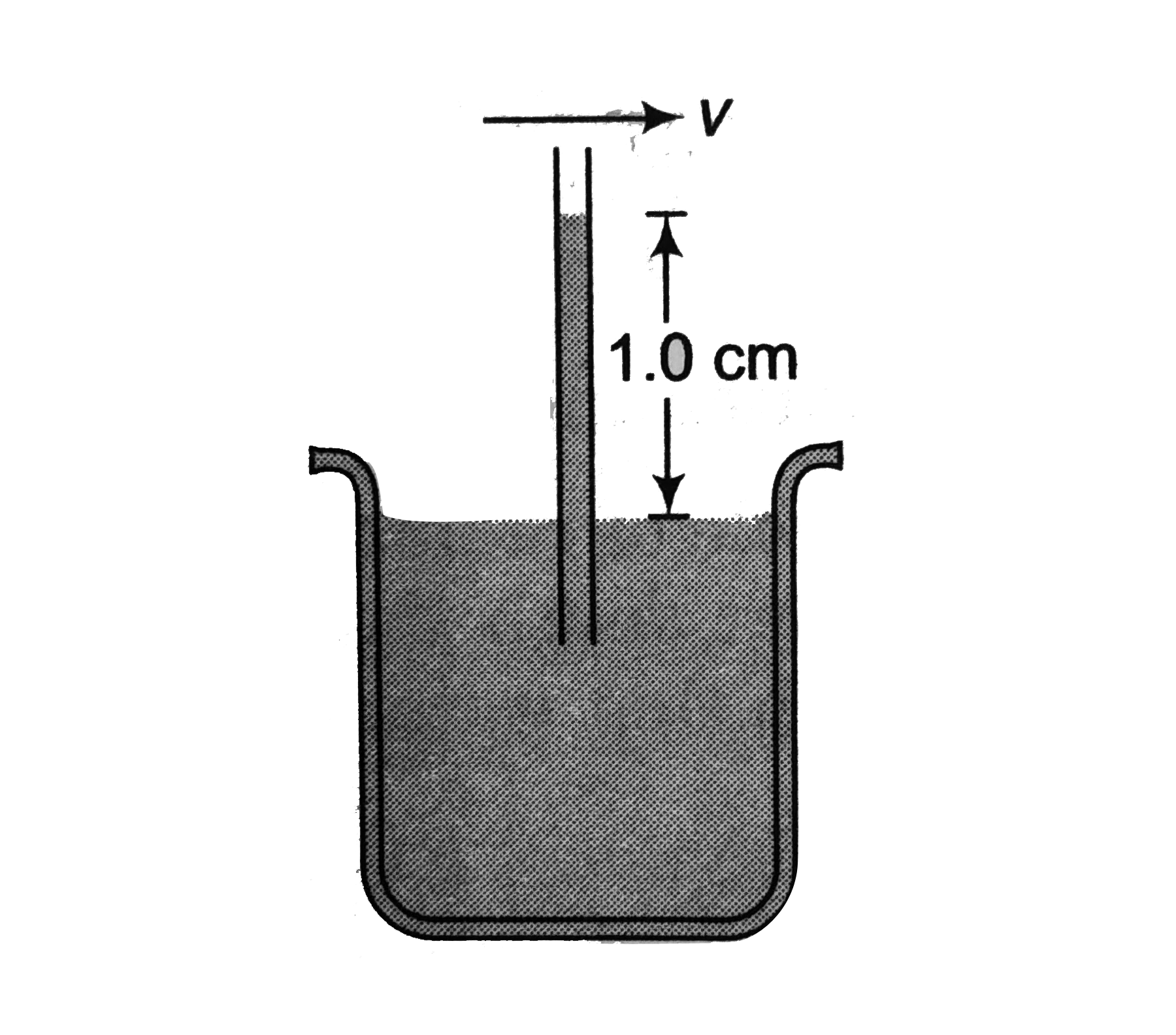
When air of density `1.3kg//m^(3)` flows across the top of the tube shown in the accompanying figure, water rises in the tube to a height of `1.0cm`. What is the speed of air?

A

`12.4m//s`

B

`12.5m//s`

C

`12.8m//s`

D

`15.0m//s`

Text Solution

Verified by Experts

The correct Answer is:

A
Promotional Banner

Similar Questions

Explore conceptually related problems

A light cylindrical tube 'T' of length l and radius 'r' containing air is inverted in water (density d). One end of the tube is open and the other is closed A block 'B' of density 2d is kept on the tube as shown in the figure. The tube stays in equilibrium in the position shown. (Assume the atmosphere pressure is to be P_(0) ) Assume that density of air is very small than density of block and water. Pick up the correct statement (s)

A capillary due sealed at the top has an internal radius of r = 0.05 cm . The tube is placed vertically in water, with its open end dipped in water. Find greatest interger corresponding to the length (in water) of such a tube be for the water in it to rise in these conditions to a height h = 1 cm ? The pressure The pressure of the air is P_(0) = 1 atm . = 7 cm of Hg , density of Hg = 13.6 //cm^(3) , g = 9.8 m//sec^(2) The surface tension of water is sigma = 70 "dyne"//"cm" . (assume temperature of air in the tube is constant)

At the middle of the mercury barometer tube there is a little column of air with the length l_(0) and there is vacuum at the top as shown. Under the normal atmospheric pressure and the temperature of 200 le,vom/ l_(0)=10cm . What will be the length of the air column if the temperature rises to 330 kelvin? (Neglict expansion of the tube)

Water rises to a height of 16.3 cm in a capillary of height 18 cm above the water leve. If the tube is cut at a height of 12 cm -

A tuning fork vibrating with a frequency of 512 Hz is kept close to the open end of a tube filled with water , figure. The water level in the tube is gradually lowerd. When the water level is 17cm below the open end, maximum intensity of sound in heard. If the room temperature is 20^(@)C , calculate (a) speed of sound in air at room temperature. (b) speed of sound in air at 0^(@)C (c) if the water in the tube is replaced with mercury, will there be any difference in your observations?

Water rises to a height h in a capillary tube lowered vertically into water to a depth l as shown in the figure. The lower end of the tube is now closed, the tube is the taken out of the water and opened again. The length of the water column remaining in the tube will be .

The figure shows a crude type of perfume atomizer. When bulb at A is compressed, air flows swifty through the tiny BC with uniform speed v , there by causing a reduced pressure at the position of verticall tube DE . The liquid of density 500kg//m^(3) , then rises in the tube, enters tube BC and sprayed out. When bulb is in natural position the air in the bulb and tube are at atmospheric pressure P_(0=15)^(5)N//m^(2) . When bulb A is compressed, it creates an exces pressure Deltap=0.001P_(0) inside the bulb A . Density of air is 1.3 kg//m^(3) . If the magnitude of minimum value of speed v required to cause the liquid to rise to tube BC is 5km//s . Find the value of k . ( g=10m//s^(2) )

A rain drop with radus 1.5 mm falls from a cloud at a height 1200 m from ground . The density of water is 1000 kg//m^(3) and density of air is 1.2 kg//m^(3) . Assume the drop was spherical throughout the fall and there is no air drag. The impact speed of the drop will be :

Figure shows a large closed cylindrical tank containing water, Initially the air trapped above the water surface has a height h_(0) and pressure 2p_(0) where p_(0_ is the atmospheric pressure. There is a hole in the wall of tank at a depth h_(1) below the top from which water comes out. A long vertical tube is connected as shown. (a) Find the height h_(2) of the water in the long tube above the top initially. (b) Find the speed with which water comes out of hole.(c)Find the height of the water in the long tube above the top when the water stops coming out of the hole.
