Home
Class 12
PHYSICS
Two parallel rails with negligible resis...

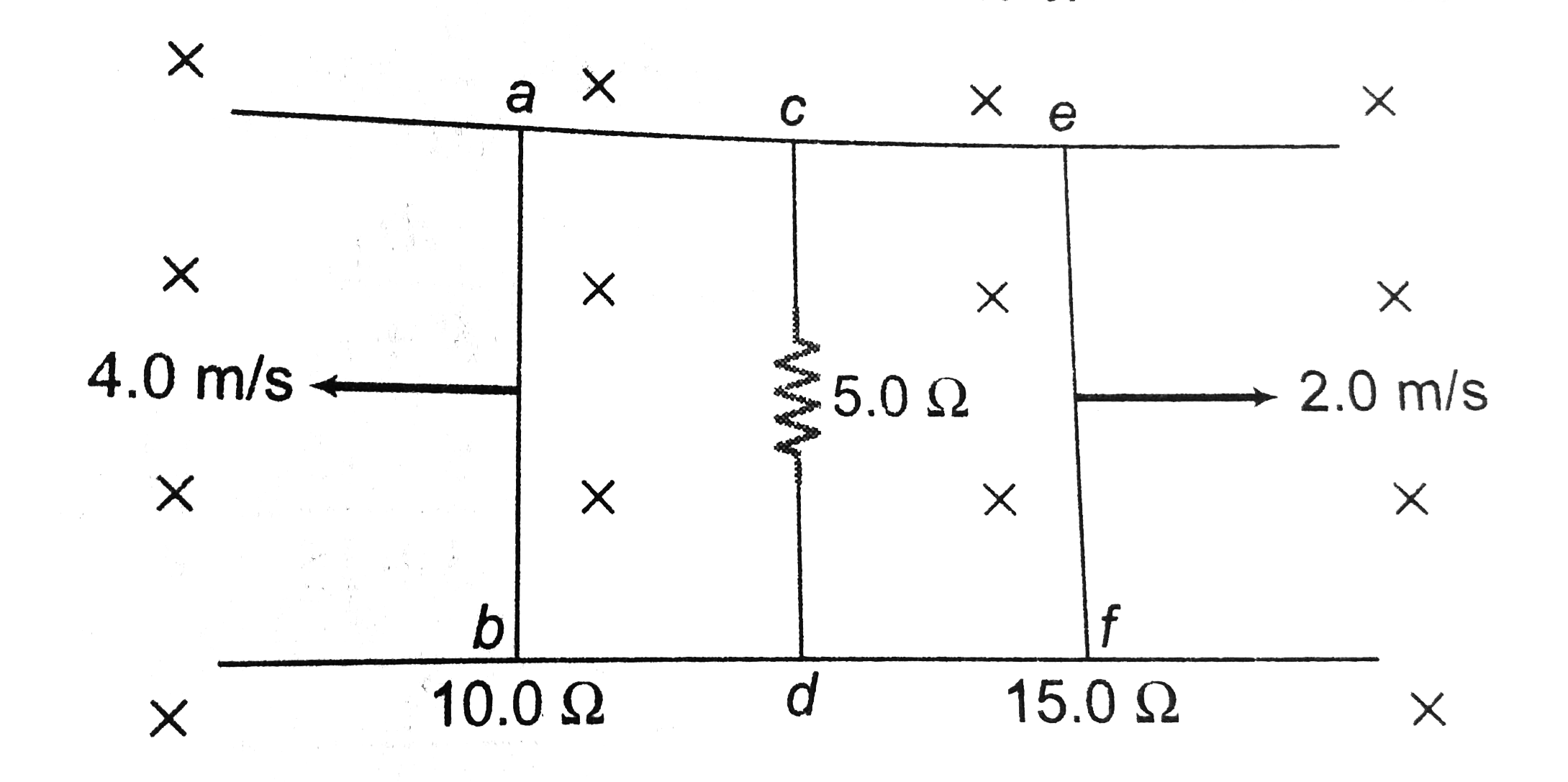
Two parallel rails with negligible resistance are `10.0 cm` apart. The are connected by a `5.0Omega` resistor. The circuit also contains two metal rods having resistances of `10.0Omega` and `15.0Omega` along the rails. The rods are pulled away from the resistor at constant speeds `4.00 m/\s` and `2.00 m//s` respectively. A uniform magnetic field of magnitude `0.01 T` is applied perpendicular to the, plane of the rails. Determine the current in the `5.0Omega` resistor.

Text Solution

Verified by Experts

In the figure `R=5.0 Omega, r_(1) = 10 Omega, r_(2) = 15 Omega`,
`e_(1) =Blv_(1) = 0.01 xx 0.1 xx 4 = 4 xx 10^(-3)V`
`e_(2) =Blv_(2) = 0.01 xx 0.1 xx 2 = 2 xx 10^(-3)V`
Applying Kirchoff.s law to the left loop :
`10 i_(1) +5(i_(1) - i_(2)) = 4 xx 10^(-3) implies 15i_(1) -5i_(2) = 4 xx 10^(-3) to (1)`
Right loop : `15i_(1) - 5(i_(1) - i_(2)) = 2 xx 10^(-3)`
`implies 20i_(2) -5i_(1) = 2 xx 10^(-3) to (2)`
Solving (1) and (2) gives : `i_(1)=(18)/(55) xx 10^(-3) A` and `i_(2) = (10)/(55) xx 10^(-3)` A
`implies` Current through `5 Omega=i_(1)-i_(2)=(8)/(55) xx 10^(-3)A=(8)/(55) mA`.
Promotional Banner

Topper's Solved these Questions

  • ELECTROMAGNETIC INDUCTION

    AAKASH SERIES|Exercise EXERCISE-IA|58 Videos
  • ELECTROMAGNETIC INDUCTION

    AAKASH SERIES|Exercise EXERCISE-IB|18 Videos
  • ELECTRIC FIELD AND POTENTIAL

    AAKASH SERIES|Exercise PROBLEMS (LEVEL-II)|26 Videos
  • ELECTROMAGNETIC WAVES

    AAKASH SERIES|Exercise EXERCISE -II|22 Videos

Similar Questions

Explore conceptually related problems

Two resistors having resistance 4 Omega and 6 Omega are connected in parallel. Find their equivalent resistance.

A vertical ring of radius r and resistance on R falls vertically. It is in contact with two vertical rails which are joined at the top. The rails are without friction and resistance. There is a horizontal uniform, magnetic field of magnitude B perpendicular to the plane of the ring and the rails. When the speed of the ring is v , the current in the section PQ is

A vertical ring of radius r and resistance on R falls vertically. It is in contact with two vertical rails which are joined at the top. The rails are without friction and resistance. There is a horizontal uniform, magnetic field of magnitude B perpendicular to the plane of the ring and the rails. When the speed of the ring is v , the current in the section PQ is

These resistors of 10Omega,15Omega and 5Omega are connected in parallel. Find their equivalent resistance.

Three resistors of 1 Omega, 2 Omega and 3 Omega are connected in parallel. The combined resistance of 3 resistors should be

A rod of mass 0.720 kg and radius 6 cm rests on two parallel rails that are d=12 cm apart and length of rails is L=49 cm. The rod carried a current of I=48 A Fig. and rolls along the rails without slipping. A uniform magnetic field of magnetude 0.240 T is directed perpendicular to the rod and the rails. If it starts from rest, what is the speed of the rod as it leaves the rails?

A copper rod of mass m slides under gravity on two smooth parallel rails l distance apart set at an angle theta to the horizontal. At the bottom, the rails are joined by a resistance R . There is a uniform magnetic field perpendicular to the plane of the rails. the terminal valocity of the rod is

A copper wire ab of length l , resistance r and mass m starts sliding at t=0 down a smooth, vertical, thick pair of connected condcuting rails as shown in figure.A uniform magnetic field B exists in the space in a direction perpendicular to the plane of the rails which options are correct.

A 5V battery with internal resistance 2Omega and a 2V battery with internal resistance 1Omega are connected to a 10Omega resistor as shown in the figure. The current in the 10Omega resistor is

There is a pair of fixed, parallel rails of negligible resistance in a horizontal plane, at a distance of L = 10 cm. The rails are connected, at one of their ends to an ideal battery of EMF 0.5 V, as shown in the figure. The system is placed in a vertically downward and perpendicular magnetic field of magnetic induction B = 1T. A metal rod of resistance R=10Omega is placed perpendicularly on the rails. The rod placed perpendicularly on the rails. The rod and rails are frictionless. The magnitude of force, which is to be exerted on the rod in order to move it with a constant speed of order to move it with a constant speed of 1ms^(-1) in the direction shown, is
